On the cultural map of Nanjing’s Gulou District, two major intangible cultural heritage projects shine side by side—Nanjing Porcelain Engraving and Jinling Scriptural Engraving. One “engraves” on porcelain, the other “engraves” on wood, together carrying forward the artisanal legacy of Jinling’s thousand-year cultural heritage.
I. Nanjing Porcelain Engraving: A Sculpting Knife on a White Porcelain Canvas
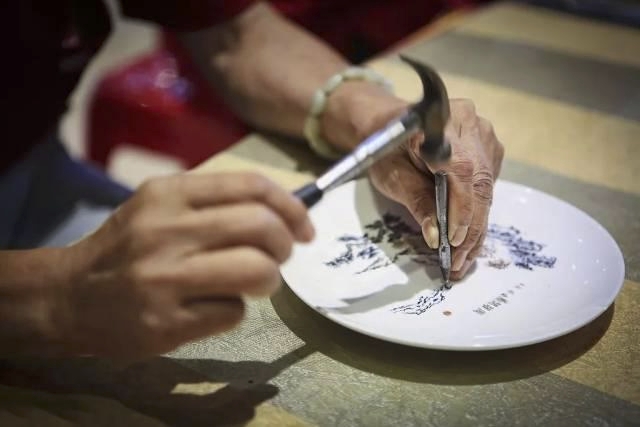
Nanjing Porcelain Engraving is a Jiangsu Provincial Intangible Cultural Heritage representative project, often hailed as “embroidery on porcelain.” This craft uses a carving knife as a brush to inscribe calligraphy and painting onto the surface of porcelain, blending the beauty of painting with the charm of seal carving to create a unique art form with distinctive Jinling character.
Historical Origins: A Craft Transmitted from Imperial Courts to the People
The art of porcelain engraving originated during the Northern and Southern Dynasties, developed with the flourishing of ceramic arts during the Song Dynasty, and emerged as a distinct craft system during the Qing Dynasty. Qing-era porcelain engraving integrated painting, calligraphy, and seal carving—the “Ink-colored Imperial Cotton-Planting Album” now housed at the Nanjing Museum stands as a masterpiece of Qianlong-era porcelain engraving. In the 1960s, the Nanjing Arts and Crafts Research Institute invited the renowned porcelain engraving master Zhu Xiaoshan to teach apprentices, allowing Nanjing Porcelain Engraving to inherit traditional techniques while incorporating Jinling cultural elements, elevating it to a highly distinctive craft form. Notable contemporary inheritors include Tao Shucheng and Huang Ling.
Carving Techniques: Three Skills That Test the Craftsman’s Mastery
The core technique of Nanjing Porcelain Engraving lies in “carving,” primarily encompassing three methods: dot carving, flat carving, and chisel carving. Among these, dot carving is the most intricate—the craftsman uses variations in dot size, depth, and density to create three-dimensional images, capturing the spirit of figures and the grandeur of famous mountains on porcelain pieces as small as a palm.
The carving tools are made of alloy steel. The porcelain surface is hard and slippery—too much force and the piece cracks; too little and no mark is left. “A steady hand and a tranquil mind” is the benchmark for a true master. A single porcelain engraving piece often requires months or even years to complete. For example, inheritor Tao Shucheng’s representative work The Yangtze River Panorama, based on a Song Dynasty painting, took a full two years to complete on a six-meter-long scroll.
Innovative Attempts to Integrate into Modern Life
In recent years, inheritors of Nanjing Porcelain Engraving have actively explored the path of “preserving tradition while embracing innovation,” experimenting with modern everyday objects such as coffee cups and red-glazed cups as canvases. For instance, inheritor Tao Shucheng has combined red-glazed coffee cups with porcelain engraving, using the glaze’s color to make the engraved patterns appear as lively as paper-cuts—a clever fusion of traditional craft and contemporary life. Additionally, to appeal to younger audiences, artisans have created a range of cultural and creative products, including “Su Chao” football-themed porcelain engraved fridge magnets, and actively carry out “intangible heritage into campuses” activities, injecting fresh vitality into this ancient craft.
Shopping Guide
In Gulou District’s cultural streets such as Jinyin Street and Taogu Xincun, as well as the Nanjing Arts and Crafts Building, you can find porcelain engraving pieces crafted by inheritors or apprentices. Common items include:
-
Porcelain Engraved Coasters and Pendants: Small in size, carved with landscapes, flowers, and birds—perfect for tea table decoration or everyday use. Affordable, suitable for beginner collectors or as souvenirs.
-
Porcelain Engraved Decorative Plates and Ornaments: More finely crafted, featuring themes such as Jinling’s famous landmarks and traditional painting and calligraphy—both ornamental and collectible.
II. Jinling Scriptural Engraving: A Woodblock Treasure of Human Intangible Heritage
Jinling Scriptural Engraving is a National Intangible Cultural Heritage project, and in 2009 it was inscribed on UNESCO’s Representative List of the Intangible Cultural Heritage of Humanity.
Jinling Scriptural Engraving Office was founded in the fifth year of the Tongzhi reign of the Qing Dynasty (1866) by Yang Renshan, a lay Buddhist and pioneer of modern Chinese Buddhist cultural revival. It is located at No. 35 Huaihai Road, Gulou District. The office houses approximately 125,000 woodblocks of Buddhist scriptures in Chinese and 18 large Buddha image blocks, making it the world’s largest repository of Chinese woodblock Buddhist scripture carvings.
The craft is divided into three major processes—block carving, printing, and binding—encompassing over twenty steps including calligraphic transcription, pattern transfer, carving, ink application, paper pressing, page separation, folding, collation, and thread binding. To this day, it is transmitted through the master-apprentice oral instruction and hands-on demonstration method. At the Jinling Scriptural Engraving Office, a single woodblock takes a skilled artisan half a month to a month to complete from transcription to finished block—the entire process is done by hand, much as it was when woodblock printing was first invented over a thousand years ago.
Shopping Guide
The Jinling Scriptural Engraving Office itself does not directly sell products to tourists. However, leveraging the prestige of this UNESCO-listed heritage, a cultural and creative brand named “Zichuan” (Word Transmission) has been developed, featuring items such as cushions, mugs, tea mats, ceramic plates, silk scarves, and canvas bags. Additionally, at relevant cultural markets or intangible heritage fairs, you may occasionally find sutra rubbings and bookmarks produced using woodblock printing techniques—the paper and ink have a rustic, antique quality that exudes literary elegance and collectible value.
III. Practical Information
| Category | Nanjing Porcelain Engraving | Jinling Scriptural Engraving |
|---|---|---|
| Heritage Level | Jiangsu Provincial | National / UNESCO Human Intangible Heritage |
| Recommended Places to Visit | Jinyin Street, Taogu Xincun, Nanjing Arts and Crafts Building | Jinling Scriptural Engraving Office (No. 35 Huaihai Road—viewing only, no direct sales); cultural products can be found at cultural markets or online platforms |
| Representative Products | Porcelain engraved coasters, pendants, decorative plates | “Zichuan” cultural and creative series; woodblock sutra rubbings (at markets) |
| Average Spending | From tens to hundreds of RMB | From tens to hundreds of RMB |
Note: Prices may vary depending on piece size, craftsmanship complexity, and whether the work is personally made by a master—please check on-site for actual prices.
Nanjing Porcelain Engraving uses the knife as a brush to etch Jinling’s mountains, waters, and everyday life onto tiny porcelain canvases; Jinling Scriptural Engraving uses wood as paper to safeguard the torch of a thousand-year cultural heritage through countless carvings. These two intangible cultural heritage treasures together inscribe the most profound chapter of “Handmade Nanjing” in Gulou District.