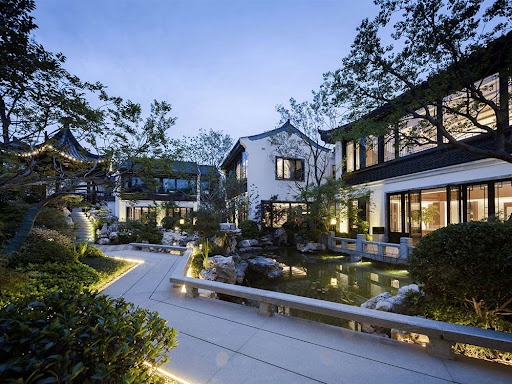
At seven o’clock in the morning, the mist had not yet lifted from the Tangshan Fangshan Geopark; dew clung to the tips of the bamboo leaves like tiny lenses. The museum’s glass curtain wall reflected the rising sun, as smooth as a piece of quartz freshly extracted from the Earth’s crust.
Stepping into the exhibition hall, the fossilised skull of the Nanjing Homo erectus lies quietly in a climate-controlled display case. Dating back 600,000 years, it features high brow ridges and a rugged jawline, yet exudes a strange sense of serenity. The researcher explained that this was a middle-aged woman who died at around the age of thirty. A touchscreen beside the display case showed a reconstruction of her face—dark skin, deep-set eyes—standing in the dense forest of Tangshan, a stone flake clasped in her hand. That moment and this one are separated by glass: one hunting 600,000 years ago, the other gazing 600,000 years later, with an entire ice age lying between them.
Leaving the museum, the road to the Yangshan Stele site winds its way uphill. The stele’s base lies horizontally on the hillside, like the forgotten foundation of a temple. The body of the stele leans against the mountainside, over seventy metres long, its surface still bearing the chisel marks of Ming Dynasty craftsmen—rows of parallel lines so fine they resemble the teeth of a comb. Only upon closer inspection does one realise that each of these ‘comb teeth’ is as wide as the palm of a hand.
Sitting in the shade beneath the stele to rest, I reached out to touch those chisel marks; the cool stone conveyed a faint sense of roughness. Six hundred years ago, over ten thousand craftsmen worked here, carving away for a full ten months. Then the project came to an abrupt halt, as no one could transport these three colossal stones to the Ming Xiaoling Mausoleum. They were left where they stood, transforming from discarded materials of the Ming Dynasty into a world record; they have lain on the mountainside for six hundred years, and will lie there for another six hundred.
At midday, we arrived at the Quarry Park, where the abandoned vertical kiln of the former cement factory still stood, its red bricks and steel reinforcements exposed like the skeleton of a giant beast. Looking down from the Sky Walkway, the pool at the bottom of the quarry was as green as a piece of jade, with a waterfall cascading from the cliff top; occasionally, a tiny rainbow would appear amidst the mist. Children screamed as they slid down the slides in the non-motorised playground; their laughter echoed through the quarry, shattering the silence of the industrial era. An elderly man sat on a bench, gazing at the rock face where quarrying once took place, and said, ‘I used to work here when I was young. When they set off the blasting charges, half the mountain would shake.’ Now, moss and shrubs have grown over the mountain’s wounds, and the waterfall flows over the scars, transforming the site into a scenic spot. It turns out that time is truly the finest healer.
In the afternoon at Yishang Hot Springs, the waters of Tangshan well up from the earth, carrying the scent of sulphur. As I submerged my entire body in the 42-degree water, the weariness brought by the stones and the silence of the mine both softened and dissolved.
A stone stele by the pool is inscribed with the words: ‘Tangshan Hot Springs, dating back to the Qin and Han dynasties, with a history spanning two thousand years.’ The water from two thousand years ago still flows; the rocks from six million years ago still lie within the mountain; and the skull from sixty thousand years ago still rests in the museum. Humans are but fleeting travellers in this vast river of time; even a brief soak in this pool is a great luxury.
We arrived at Huanglongxian at dusk. The tea gardens spread out across the hillside; the tea rows resembled a green musical stave, with the conical hats of the tea-pickers rising and falling amongst the notes. Sitting on a bamboo chair by the tea garden, the landlady brought over a cup of Jinling Spring; the tea liquor was clear and bright, with the aroma of chestnuts on the palate. ‘This is the first harvest of the year, picked before Qingming,’ she said. ‘It takes fifty thousand buds to make one jin of tea.’ Fifty thousand bends of the back, all for this single cup. The setting sun sank beyond the tea rows, bathing the entire hillside in a golden-green glow, whilst the tea-pickers, bamboo baskets slung over their shoulders, made their way down the mountain, their shadows stretching long and far between the rows.
On the return journey, as we passed Baijia Lake, night had already fallen. The neon lights of the 1912 Quarter were reflected on the lake’s surface, whilst the Ferris wheel turned slowly against the night sky, like a ring rotating gently. From the lakeside restaurants, the sound of a guitar drifted out, mingling with the singing as it dispersed over the water. The skulls seen in the museum that day, the chisel marks felt on the Yangshan stele stones, the warmth felt in the hot spring pools, and the aroma of tea savoured in the tea gardens—all of these now settled and merged into the calm waters of the lake. Jiangning is so vast that one can only scratch the surface in a single day, yet these fragments, pieced together, are enough to leave a lasting impression.
As I left late at night and looked back at Baijia Lake, the lights along the shore were still ablaze, like hot spring water bubbling up from the depths of the earth, carrying the warmth of the earth’s core, shining on and on towards the far reaches of the night sky. The Peking Man of Tangshan, the stonemasons of Yangshan, the concrete workers in the mine shafts, and the tea pickers of Huanglongxian have all left their marks on this land. The old traces remain, whilst new ones are emerging—the waterfall cascading over the mine shaft, the Starry Sky Restaurant in front of the former cement factory site, and that preserved, rust-stained vertical kiln, standing like a monument, pointing to the sky as if to say: ‘I am still here.’ This is Jiangning: ageing at a leisurely pace, yet teeming with life.