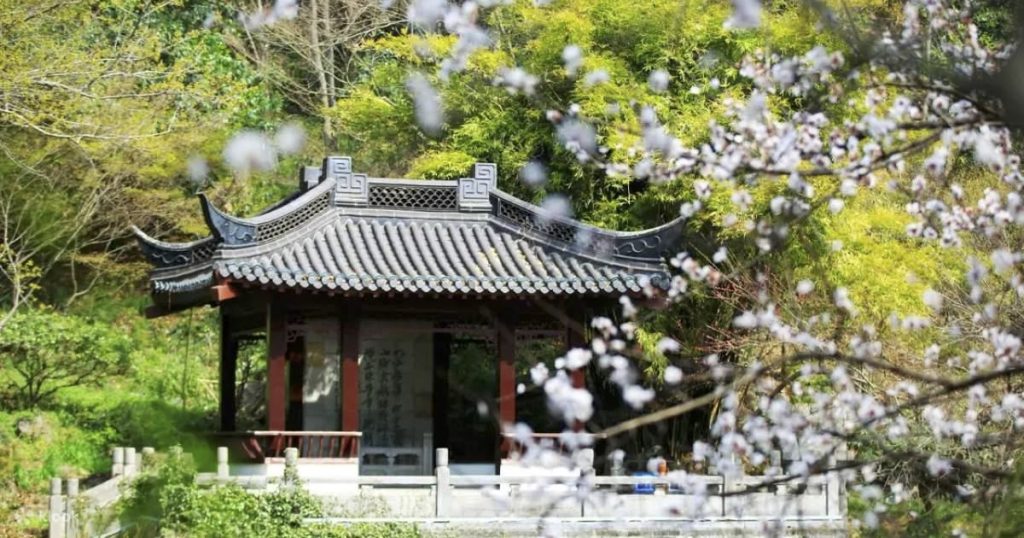
This itinerary sets off from the ancient Mount Qixia and winds its way along the Yangtze River, allowing you to experience the profound significance of the saying ‘One Mount Qixia, half the history of Jinling’, before bringing the day’s journey to a close amidst the sunset and the bustling atmosphere by the river.
Morning: A prime spot for autumn foliage and a millennium-old temple
First stop: Qixia Mountain (approx. 3–4 hours)
Alight at ‘Nanda Xianlin Campus Station’ or ‘Jingtian Road Station’ on Metro Line 2, then take a bus or a taxi to the mountain. Qixia Mountain is one of China’s four premier destinations for viewing autumn foliage and is renowned for the saying, ‘One Qixia Mountain, half the history of Jinling’. Once inside the mountain, you can follow the route: Mingjing Lake → Qixia Temple → Stupa of the Buddha’s Relics → Thousand Buddha Caves → Taohua Lake → Taixu Pavilion → Fenglin Lake → the spot where the First Emperor gazed upon the river.
Key highlights include
Qixia Temple: Originally built during the Southern Dynasties, it is one of the few ancient temples from the ‘480 temples of the Southern Dynasties’ to have survived to this day and remains a bustling place of worship.
Qianfo Cave and the Stupa of the Sacred Relics: Located behind the temple, Qianfo Cave houses hundreds of stone Buddha statues and is hailed as the ‘Yungang of Jiangnan’; the largest cave contains a statue of the Buddha of Infinite Life standing over ten metres tall. The Stupa of the Sacred Relics is a stone pagoda from the Southern Tang period, featuring exquisite carvings.
The Spot Where the First Emperor Gazed upon the River: Upon reaching the summit of Fengxiang Peak (284 metres above sea level), it is said that the First Emperor of Qin once gazed out over the Yangtze River from this spot. The view is exceptionally expansive, offering a spectacular panorama of the Yangtze River and the Nanjing Yangtze River Fourth Bridge.
If you visit in autumn (late October to November), the mountains are ablaze with the colours of sweetgum, red maple and Japanese maple. The areas around Taixu Pavilion, Taohua Lake and Fenglin Lake are widely regarded as the best vantage points for viewing the foliage.
Lunch Recommendations (approx. 1 hour)
After descending the mountain, you can enjoy a bowl of vegetarian noodles at the vegetarian restaurant in Qixia Temple; the broth, simmered with mushrooms, is rich and flavourful. Alternatively, at a local farmhouse restaurant in Qixia Town at the foot of the mountain, you can sample seasonal wild vegetables such as Baiguazhou water spinach and mugwort.
Afternoon: Sunset by the River and Historical Sites
Third Stop: Yanziji (approx. 1.5 hours)
It takes about 20–30 minutes to reach Yanziji by taxi or bus from Qixia Mountain. Yanziji is the foremost of the Yangtze River’s three famous cliffs; named for its resemblance to a swallow spreading its wings, it is an excellent spot for watching the sunset over the Yangtze. Inside the Imperial Stele Pavilion at the summit stands a stone stele inscribed with the words ‘Yanziji’ in Emperor Qianlong’s own handwriting. Standing at the cliff’s edge, you can take in the sweeping view of the river and the passing vessels; with a bit of luck, you may even spot Yangtze finless porpoises frolicking in the water.
Fourth Stop: Muyan Riverside Scenic Belt (approx. 1–1.5 hours)
It takes about 15 minutes to walk or cycle along the Yangtze River from Yanziji to reach this area. This is an approximately 8-kilometre-long riverside greenway that connects attractions such as Mufu Mountain, the Yangtze River Guanyin Scenic Area and Wumadu Square. Wumadu Square is an important cultural landmark of the Yangtze River in Nanjing. Legend has it that towards the end of the Western Jin Dynasty, five horses crossed the river here, and one of them transformed into a dragon, symbolising Sima Rui’s establishment of the Eastern Jin Dynasty. From here, you can gaze out at the Nanjing Yangtze River Bridge and Bagua Island; with the river breeze caressing your face, the view is exceptionally expansive.
Evening and Night: Night-time Views of the River Islands and the Vibrant City Life
Fifth Stop: Bagua Island (approx. 1.5 hours, optional)
If time permits, you can take a ferry from Yanziji Pier to Bagua Island. Bagua Island is a riverine islet in the middle of the Yangtze River, renowned for crops such as reed and water spinach. The Zhoutou Wetland Park is ideal for a stroll; at dusk, you can watch the sun set over the river and admire the Nanjing Yangtze River Bridge in the distance.