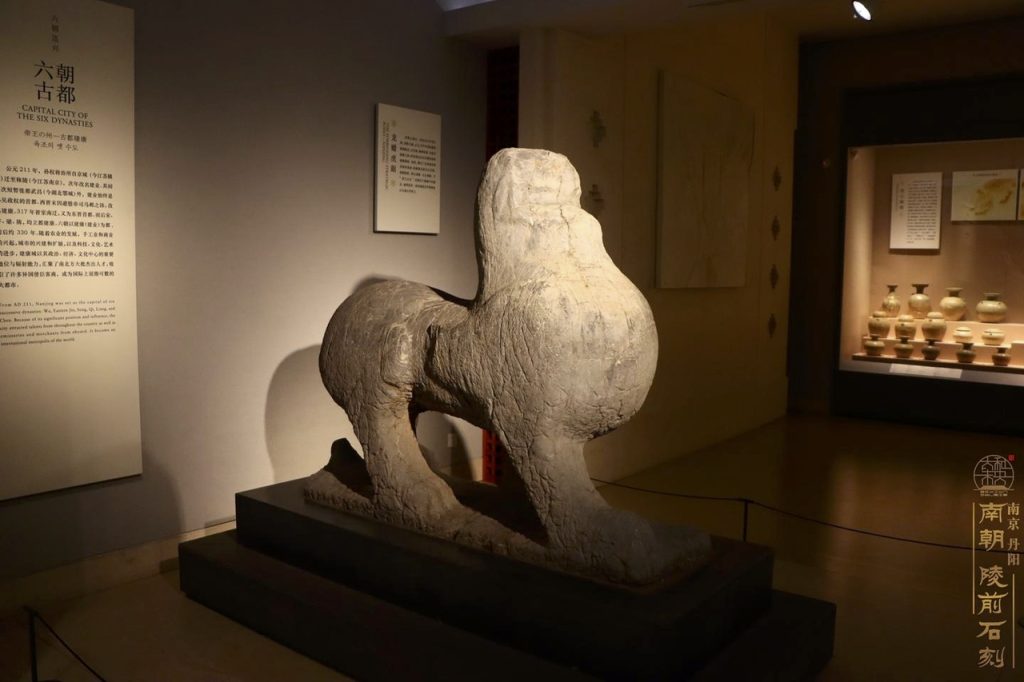
Scattered across the fields, villages, campuses, and roadsides of Qixia District in Nanjing lies a collection of silent yet profoundly moving historical remains—the Southern Dynasties Imperial Mausoleum Stone Carvings. Qixia District boasts the highest concentration of Southern Dynasties stone carvings in the Nanjing area, with over 10 extant examples of sacred way (shendao) stone carvings, accounting for more than half of all Southern Dynasties stone carvings in Nanjing. It is acclaimed by cultural heritage experts as the “finest preservation of district-level Southern Dynasties stone carvings. “
I. Qixia: An “Open-Air Museum” of Southern Dynasties Stone Carvings
The Southern Dynasties (420–589 AD) spanned the Song, Qi, Liang, and Chen dynasties, with Jiankang (present-day Nanjing) as the capital. Members of the imperial family and nobility were predominantly buried in the outskirts of the capital. According to historical records, Qixia District is home to over 10 extant Southern Dynasties mausoleum stone carving sites. These include sites believed to be imperial mausoleums, such as the Yongning Mausoleum of Emperor Wen of Chen (Chen Qian), known as the Shizichong (Lion’s Charge) stone carvings; and those of imperial clan members and nobles, including the tombs of Xiao Hong, Prince Jinghui of Linchuan; Xiao Xiu, Prince Ancheng Kang of Liang; Xiao Hui, Prince Zhonglie of Poyang; Xiao Dan, Prince Shixing Zhongwu of Liang; and Xiao Jing, Prince Wuping Zhonghou of Liang, among others.
These stone carvings are essential components of the sacred way (shendao) leading to the mausoleums. They typically include guardian mythical beasts (stone qilin, tianlu, and bixie), sacred way stone pillars (huabiao), and sacred way steles (monuments) . They are hailed as the “crowning achievements of ancient Chinese mausoleum stone carving. “
II. The Essence of the Stone Carvings: Three Iconic Types
Southern Dynasties stone carvings can be broadly classified into three major types, each exceptional in its own right:
1. Guardian Mythical Beasts — Stone Qilin, Tianlu, and Bixie
The mythical beasts are the most visually striking elements of Southern Dynasties stone carving. In front of imperial mausoleums, the qilin (single-horned) and tianlu (double-horned) stand—both male figures, with vigorous postures, raised heads and chests, long beards, and intricately decorated bodies that exude a powerful sense of rhythm. In front of noble tombs, bixie (hornless) stands guard, equally imposing in presence.
Among the most graceful is the Shizichong (Lion’s Charge) stone carving, believed to belong to the Yongning Mausoleum of Emperor Wen of Chen (Chen Qian). A pair of stone qilin and tianlu, facing each other from east to west with a spacing of 24.45 meters, display a lively elegance that is widely recognized as an artistic masterpiece among Southern Dynasties stone carvings.
2. Sacred Way Stone Pillars (Huabiao) — A “Twin Marvel” of Calligraphy and Form
Stone pillars served as important markers along the sacred way, with inscriptions of the tomb owner’s biography often carved on the shafts. The stone pillar at the tomb of Xiao Jing, Prince Wuping Zhonghou of Liang, is particularly exquisite. Its inscription is written in “reversed left-hand script (fanzuoshu) ,” a unique form in the history of Chinese calligraphy that is virtually unparalleled in artistic value.
3. Sacred Way Steles — The Best-Preserved Southern Dynasties Inscribed Monuments
Stele inscriptions are crucial historical materials for verifying the identities of tomb occupants. The sacred way stele at the tomb of Xiao Dan, Prince Shixing Zhongwu of Liang, is the best-preserved, with clearly legible inscriptions that serve as invaluable physical evidence for the study of Southern Dynasties history and calligraphy. The tomb of Xiao Xiu, Prince Ancheng Kang of Liang, features the largest number of stone carvings, arranged from south to north as a pair of bixie, a pair of steles, a pair of stone pillars, and another pair of steles—the most extensive surviving grouping of Southern Dynasties stone carvings.
III. Preservation and Exhibition: Qixia’s Technology-Empowered Approach
Since the Southern Dynasties stone carvings are predominantly immovable cultural relics scattered across open fields, Qixia District is gradually enhancing their exhibition conditions through environmental improvements and digital technology. Key sites—including the tombs of Xiao Hong, Xiao Xiu, and Xiao Jing—have already undergone environmental upgrades, with the installation of lawns, pathways, and parking facilities, creating a Southern Dynasties Stone Carving Cultural Exhibition Route.
In the realm of digital display, the Qixia Mountain Grotto Research Institute has undertaken high-precision 3D scanning, digital modeling, and 3D-printed reproductions of stone artifacts in its collection, enabling the permanent preservation and dynamic presentation of cultural relics. In March 2026, the Longmen Grottoes Research Institute and the Qixia Mountain Grotto Research Institute jointly launched the “Integration of Hu and Han Cultures · Digital Re-illumination” Grotto Art Joint Exhibition at Qixia Ancient Town, employing digital technology to bring the “stone epic” of the Southern Dynasties back to life for contemporary audiences.
IV. Featured Exhibition Room and Visitor Experience
Adjacent to the Qixia Mountain Scenic Area, a small exhibition room displays replicas of nearby Southern Dynasties mausoleum stone carvings along with illustrative materials. The exhibits include representative artifacts such as mythical beasts, stone pillars, and steles. While smaller in scale than the main exhibition hall in Jiangning, it has the advantages of proximity and convenience—visitors can easily incorporate this stop after touring Qixia Mountain to explore the essence of Six Dynasties imperial tomb culture. The exhibition room is free of charge and is recommended to be visited alongside other Six Dynasties Buddhist sites such as the Qixia Mountain Grottoes and the Thousand-Buddha Cliff, forming a comprehensive Six Dynasties cultural heritage route.
The Southern Dynasties stone carvings represent Nanjing’s most profound and magnificent cultural imprint as the ancient capital of the Six Dynasties. Standing silently amidst the mountains and waters of Qixia, they have watched over this land for over 1,500 years, waiting for every mindful visitor to listen to the “dreamlike” stone epic of the Six Dynasties.