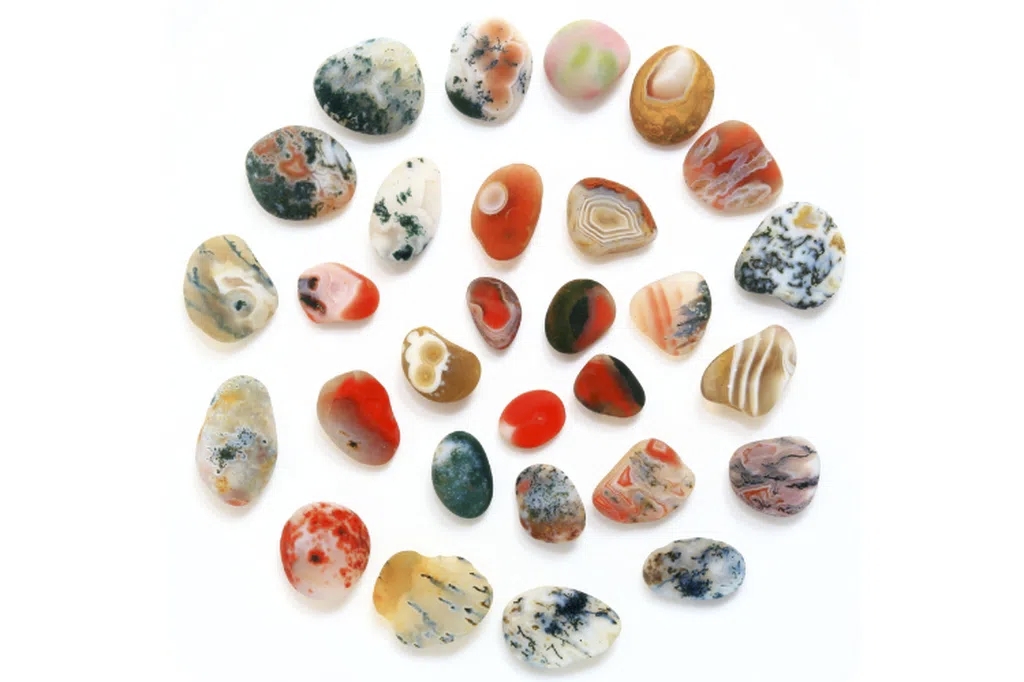
Yuhua stones are a type of natural agate, also known as “pattern stones,” “ornamental stones,” or “lucky stones.” They are primarily produced in the Liuhe District of Nanjing and the Yuezheng Township area of Yizheng, Yangzhou, making them a famous specialty of Nanjing and Yizheng. Named for their “flower-like” patterns and their association with rain, these stones are exquisitely beautiful and are celebrated as the “Heaven-Bestowed National Treasure, a Unique Wonder of China” and the “Queen of Stones.”
I. The Origin of the Name: A Fusion of Myth and Legend
The name “Yuhua Stone” (Rain-Flower Stone) derives from a beautiful legend. According to the tale, during the Liang Dynasty of the Southern Dynasties, the eminent monk Master Yunguang delivered Buddhist sermons at Shizigang (Stone Hill) outside the Zhonghua Gate of Nanjing. So profound was his devotion that it moved the heavens, and a rain of five-colored flowers fell from the sky, transforming into colorful patterned stones upon landing on the earth. Hence the name “Yuhua Stone” (Rain-Flower Stone), and the site of his sermons was renamed Yuhuatai (Rain-Flower Terrace). The Chinese idiom “tianhua luandui” (heavenly flowers falling in profusion) originates from this legend, and the Yuhua stone has since become a symbol of Nanjing.
However, this is merely a beautiful myth. The actual origin of Yuhua stones is not Yuhuatai, but the Liuhe and Yizheng areas—a common misconception held by many.
II. Scientific Formation: A Gift from the Earth Over 12 Million Years
Modern science has unlocked the mystery behind Yuhua stones. They were formed during the Cenozoic Era, approximately 12 million to 3 million years ago. During this period, frequent volcanic activity filled cavities and fissures in volcanic rocks (such as basalt and rhyolite) with silica-rich hydrothermal solutions. These silica-rich solutions cooled and deposited layer by layer from the outside in, forming agate with concentric, banded patterns.
Subsequently, through crustal movements, flash floods, and water transport, the primary agate detached from the rock formations, was polished into rounded pebbles in the ancient Yangtze River system, and ultimately deposited in the “Yuhuatai Gravel Bed.” The international geological community has officially named this Neogene stratum the “Yuhuatai Formation Gravel Bed.”
III. Composition and Classification: The Colorful Spectrum of Nature’s Palette
The primary component of Yuhua stones is silica (SiO₂) , with a hardness of 6 to 7 on the Mohs scale. They display a stunning array of colors, which vary according to the trace elements incorporated during formation: red from iron, blue from copper, purple from manganese, and the varying concentrations of these elements determine the intensity and shade of the colors.
Based on mineral composition, Yuhua stones can be classified into agate type, chalcedony type, quartz type, rock crystal type, opal type, siliceous rock type, and fossil type. In a broad sense, Yuhua stones refer to all ornamental pebbles produced in the “Yuhuatai Gravel Bed”; in a narrow sense, they specifically refer to the high-grade ornamental stones—primarily agate—produced in Nanjing and its surrounding areas. They are also divided into fine stones (primarily agate, delicate and colorful) and coarse stones (coarser in texture, of lower value).
IV. Unique Value: A “Living Fossil” Possessing Six Qualities of Beauty
Yuhua stones are treasured for their six qualities of beauty: texture, form, pattern, color, imagery, and artistic conception. Their concentric patterns evolve naturally from voids within the stone, making each piece utterly unique and irreplaceable. Some Yuhua stones even contain fossils from 20 million years ago—corals, nautiloids, and Psaronius tree ferns—making them valuable materials for paleontological research. Thus, Yuhua stones are not merely ornamental; they are “recorders” of environmental change throughout Earth’s history.
Yuhua stones are among the earliest natural ornamental stones appreciated by humans in the world. As early as the Neolithic Age (approximately 6,000 years ago), 76 Yuhua stones were unearthed at the Beiyinyangying site in Nanjing, demonstrating that ancient peoples had already endowed them with cultural significance. The Song Dynasty text Yunlin Shipu (Cloud Forest Stone Catalog) contains records of agate stones from Liuhe. During the Ming and Qing Dynasties, scholars and literati wrote extensively about them, producing monographs such as Illustrated Discourse on Lingyan Stones. The “Yuhua Stone Appreciation Custom” was inscribed on Jiangsu’s Intangible Cultural Heritage List in 2016.
V. Collection and Appreciation: The Pursuit of Artistic Conception
Appreciating Yuhua stones is a pursuit of “artistic conception” (yijing)—the scenes beyond the scene, the paintings beyond the frame, the overtones beyond the notes. It demands a refined cultural sensibility from the collector. Fine Yuhua stones often display naturally formed images of landscapes, figures, birds, animals, trees, and other scenes, inspiring endless reverie.
High-quality collectible stones are extremely rare—among several tons of gravel, scarcely a dozen can be found. As the saying goes, “Gold is easy to obtain, but a remarkable stone is hard to find.” On the market, ordinary small stones with patterns can command several hundred yuan, while the value of top-grade stones is far higher. Today, due to environmental protection measures, mining in the main producing areas has been progressively banned, making fine Yuhua stones even more precious.
When purchasing Yuhua stones, it is important to distinguish natural stones from artificially dyed, polished, or even plastic imitations. It is advisable to choose reputable sources such as Liuhe Hengliang Yuhua Stone Market or the Saturday market at Qingliangshan Park, and to remember the principle of “look more, buy less“—truly appreciating the exquisite patterns, brilliant colors, and profound artistic conception of natural Yuhua stones.