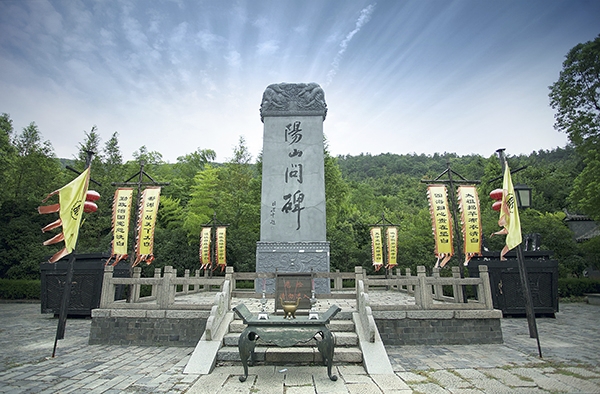
On the southern slope of Yangshan, northwest of Tangshan Subdistrict in Jiangning District, Nanjing, lie three colossal stone blocks that leave visitors in awe. They are not nature’s handiwork but the monumental remnants of an ambitious project commissioned by the Ming Dynasty’s Emperor Chengzu, Zhu Di, in honor of his father, Zhu Yuanzhang—the founding emperor of the dynasty. These three massive stones—corresponding to the base, the body, and the crown of a stele—if erected in proper arrangement, would reach a staggering total height of 78 meters, equivalent to a 26-story building, with a combined weight exceeding 30,000 tonnes—roughly the weight of over 400 China-made C919 passenger jets. They hold the Guinness World Record as the largest stele materials on Earth and are hailed as the “Number One Stele Under Heaven.”
I. An Emperor’s Piety and Ambition: Zhu Di’s Grand Design
In 1402, Zhu Di seized the throne from his nephew Zhu Yunwen through the “Jingnan Campaign” (Rebellion to Clear the Court of Unworthy Rulers). To ease the political tensions caused by his usurpation, win over public sentiment, and assert the legitimacy of his reign, Zhu Di embarked on a series of “filial projects”—and the quarrying of colossal stele materials at Yangshan to honor his father stood as the most significant among them.
Why Yangshan? First, the site had a long history of stone quarrying dating back to the Six Dynasties. Second, the Qixia limestone produced here is “dark and lustrous as lacquer,” with fine, intact texture and minimal fractures—truly “heaven-sent material.” Third, the mountain’s thick rock strata were ideal for carving super-sized stone blocks. In the autumn of the third year of the Yongle reign (1405), Zhu Di officially issued the imperial edict, summoning tens of thousands—perhaps over a hundred thousand—craftsmen from across the empire to this ancient quarry, launching what would become the most colossal engineering endeavor in the history of human stone carving.
II. Staggering Dimensions: The Enormity of the Three Monoliths
The sheer size of the Yangshan Stele Materials remains breathtaking even by modern engineering standards. Official measurements place the specifications of the three stones as follows:
-
The Base (Bixi or Tortoise Pedestal): 8.59 meters high, 11.64 meters wide, and 23.3 meters long, weighing 6,198 tonnes.
-
The Crown (Stele Top): 6 meters high, 11.74 meters wide, and 4.6 meters thick, weighing 862 tonnes. Its surface features 14 pre-carved stone protrusions for the eventual carving of dragon patterns, revealing meticulous design planning.
-
The Body (Stele Shaft): 25 meters high, 9.84 meters wide, and 4 meters thick, weighing 2,617 tonnes.
Together, the three stones would reach a total height of approximately 39.59 meters and a combined weight of 9,677 tonnes (Note: measurements vary slightly across sources due to different benchmarks, with some estimates reaching 78 meters in height and 31,000 tonnes in total weight). The body of the stele has been separated from the mountain on five sides, connected only at one end, with its base carved out into a suspended form, creating the famous “Thread of Sky” marvel—sunlight can shine directly through the gap from the top to the bottom. Standing before these stones, humans appear as tiny as ants. The Qing Dynasty poet Yuan Mei captured this awe in his Song of the Great Hongwu Stele: “The stele stands like a long sword leaning against the azure sky; a hundred thousand camels could not drag it away.“
III. Forged in Blood and Tears: Countless Souls Beneath the Stones
Such a colossal undertaking came at an appalling cost. Historical records and local lore tell that most laborers were convicts, working under a system of “penal servitude in lieu of punishment.” Craftsmen were required to deliver three sheng and three dou (roughly 6.6 liters) of stone chips per day—those who failed were executed on the spot. Over the course of just over a year, countless artisans perished from exhaustion, disease, accidents, and execution—more than three thousand in total. Their bodies were hastily buried nearby, giving rise to the haunting place name “Fentou Village” (Grave Mound Village) that exists to this day. Yuan Mei’s poem also contains the lines: “Imperial decrees harshly condemned them to the executioner’s blade; craftsmen and supervisors perished in the wells,” recording that grim chapter of blood-soaked history.
IV. Unanswered Mysteries: Why Was the Project Abandoned?
The stele materials were nearly completed, yet they never reached the Ming Xiaoling Mausoleum—which instead houses a stele of only 8.87 meters in height, less than one-fiftieth the scale of the Yangshan materials. Official historical records offer no formal explanation for the project’s abandonment. Scholars and folklore have proposed three main theories:
-
Transportation Impossible — This was the most fundamental technical hurdle. The base alone weighed 16,000 tonnes; even with the ancient methods of rolling logs and ice-sledding, the geographical and climatic conditions of Nanjing made overland transport virtually unachievable.
-
Relocation of the Capital — In the 19th year of Yongle (1421), Zhu Di moved the capital to Beijing, diminishing Nanjing’s political status; such a gargantuan project gradually lost its priority.
-
Political Goals Achieved — Once Zhu Di’s rule was firmly consolidated, the urgency of using a colossal stele to legitimize his reign diminished, leading to the prudent abandonment of this impractical endeavor.
V. Echoes of the Past and Present: From “Unfinished Project” to Cultural Landmark
Six centuries of wind and rain have etched weathered tool marks across these three monoliths, yet they have also created a stone-carving marvel unparalleled in the world. In 1982, the Yangshan Stele Materials were designated as a National Key Cultural Relic Protection Site, and in 2018, under the title “Number One Stele Under Heaven,” they were selected as one of the “New Forty-Eight Scenic Sights of Jinling.” Today, the Ming Cultural Village Scenic Area (a National 4A-rated attraction) has been developed around the stele remnants, recreating the scene of Ming Dynasty quarrying with features such as the Jinling Escort Agency, the Stele Remains Site, and the “Yangshan Inquiring about the Stele” exhibit. Visitors can walk through the “Thread of Sky” gap between the stone shaft and the mountain face, touch the six-century-old chisel marks, and feel the immense grandeur of the Great Ming Dynasty—and the weight of history’s lingering aftertaste.
The Yangshan Stele Material is no mere “unfinished” ancient project—it is a dynastic elegy frozen in stone. It embodies an emperor’s ambition, the blood and tears of countless craftsmen, the limits of ancient technology, and the capriciousness of history. It stands as the most awe-inspiring silent chronicle in the countryside of Nanjing.