Qiuyushan: A Cultural Gift Collection from the Sacred Place of Contemporary Chinese Calligraphy
Qiuyushan (Autumn Rain Mountain), located in Pukou District, Nanjing, stands less than 100 meters above sea level, yet its fame resonates far beyond its modest height—thanks to its profound connection with the art of calligraphy. This hallowed ground is the final resting place of Lin Sanzhi, hailed as the “Sage of Cursive Script” in modern China, along with three other master calligraphers: Hu Xiaoshi, Gao Ershi, and Xiao Xian. The mountain is home to dedicated memorial halls for each of these four masters and is widely revered as the “Sacred Place of Contemporary Chinese Calligraphy.” With its serene bamboo groves, verdant pines, and pavilions nestled among the hills, Qiuyushan offers an atmosphere of tranquility and refinement—a spiritual sanctuary for calligraphy enthusiasts and a haven for scholars and artists alike.
I. Cultural Heritage: The Brushwork Legacy of Four Masters
Lin Sanzhi (1898–1989)**, known as the “Sage of Cursive Script,” excelled in poetry, painting, and calligraphy. His unique cursive style, the “Sanzhi Style,” masterfully integrates Han Dynasty clerical script, Northern Stele inscriptions, and the techniques of Huai Su. The renowned Japanese calligraphy master Aoyama San’yu once exclaimed, “The legacy of the cursive sage lives on in this elder.”
Hu Xiaoshi (1888–1962)**, a distinguished scholar of paleography and calligraphy, was a master of stele-school calligraphy. His clerical script is celebrated for its archaic strength and grandeur. He inscribed countless steles for famous sites in Nanjing and taught at prestigious institutions such as Southeast University and Central University, nurturing generations of scholars.
Gao Ershi (1903–1977)**, a master of Zhangcao (clerical cursive script), developed his own “wild cursive” style. His scholarly integrity and calligraphic brilliance shone through in his famous treatise *A Refutation of the Authenticity of the Preface to the Orchid Pavilion Collection*, which sparked the celebrated “Orchid Pavilion Debate.”
Xiao Xian (1902–1997)**, one of the most influential female calligraphers in modern Chinese art history, was a disciple of Kang Youwei. Her monumental large-character calligraphy is known for its boldness and vigor, earning her the title of “Female Sage of Calligraphy.” She remained devoted to the brush throughout her life.
In 1988, the Lin Sanzhi Memorial Hall was the first to be established on Qiuyushan, followed by halls for Hu Xiaoshi, Gao Ershi, and Xiao Xian. Together, they form the “Four Masters of Jinling,” infusing this mountain with an irreplaceable calligraphic legacy. It is often said among calligraphers: “For calligraphy, there is Lin Sanzhi; for the spirit of the art, there is Qiuyushan and the Four Masters of Jinling.”
II. Design Philosophy: Where Traditional Craft Meets Calligraphic Aesthetics
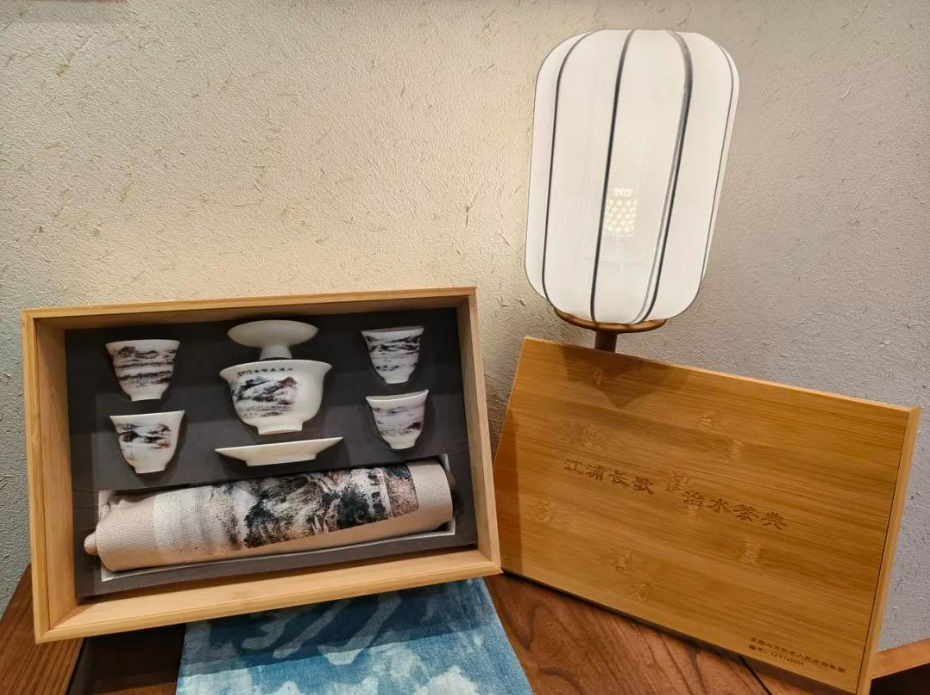
Drawing inspiration from the ink poetry of Qiuyushan and the authentic brushwork of the Four Masters, contemporary artisans have crafted a collection of cultural gifts imbued with the warmth of Jinling’s literary heritage. These creations span a wide range of forms, including high-quality calligraphy reproductions(on fine rice paper, capturing every nuance of the brush), custom calligraphy pieces(commissioned with specific poems or texts), calligraphic art ornaments(carved in bamboo, wood, or stone), purple clay tea wares (inscribed with calligraphy), fine folding fans (bearing original brushwork), paperweights (with master calligraphy engraved in relief or intaglio), and ceramic scholar’s studio pieces (brush washers, brush rests, and more). These items bring calligraphic art from the gallery into daily life, preserving a thousand-year cultural tradition through practical use.
These cultural gifts seek not merely visual beauty but a deeper spiritual resonance—embodying the scholar’s spirit through the form of calligraphy, and bearing the soul of the brush in the body of the object.
III. Craftsmanship Fusion: When Brush and Ink Meet Paper-Cutting and Porcelain Engraving
What truly distinguishes Qiuyushan’s cultural gifts is the innovative integration of calligraphy with Nanjing’s local intangible cultural heritage, achieving a remarkable “cross-disciplinary fusion”:
Calligraphy × Paper-Cutting: Taking the fluid rhythm of calligraphic strokes as their blueprint, paper-cutting artists wield scissors and knives to render the “flying-white” dry-brush textures of the Sanzhi Style and the sweeping flourishes of Zhangcao through the interplay of yin (cut-out) and yang (retained) techniques on red paper. The resulting lines balance strength and suppleness, void and solid, giving the ink’s tonal variations and the cursive flow an entirely new visual language. Nanjing paper-cutting, a nationally recognized intangible cultural heritage item, is known for its “flowers within flowers, themes within themes, fine details within bold forms, and spirit within simplicity.” When fused with calligraphy, it creates a unique art form of “calligraphy on paper.”
Calligraphy × Porcelain Engraving: Porcelain engraving (or “ceramic carving”) uses diamond-tipped tools to incise calligraphic strokes onto unfired or glazed porcelain. Artisans meticulously replicate the cursive script of Lin Sanzhi, the Zhangcao of Gao Ershi, and other masterworks onto porcelain plates and dishes. Through firing and glazing, the brush’s lifting, pressing, and turning are transformed into the depth and rhythm of the carving, while ink tones become the luster of translucent glazes. Each incision embodies a dialogue between hand and mind, immortalizing the beauty of calligraphy on ceramics—enduring and luminous. Technical support from institutions such as Jingdezhen Ceramic University has enabled the scaled production of these high-quality engraved porcelain works, preserving the elegance of literati calligraphy while adding the durability and brilliance of ceramic art.
IV. Corporate Gifting: A Distinguished Choice Adorned with Ink Mastery
Qiuyushan calligraphy-inspired cultural gifts are an ideal choice for corporate and business presents, offering multiple layers of value:
Cultural Depth— The Four Masters of Jinling hold an esteemed place in Chinese calligraphy history. Presenting such a gift reflects a deep respect for the recipient’s cultural sensibilities.
Artistic Excellence— The original masterworks are rendered through exquisite craftsmanship, resulting in items that are both visually captivating and functionally practical—whether displayed in an office or a study, they infuse the space with an air of refined elegance.
Artisanal Craftsmanship— Both paper-cutting and porcelain engraving are intangible cultural heritage techniques, with the warmth of handcrafting and the patina of time evident in every detail.
Symbolic Meaning— The calligraphic content often features inspirational, aspirational, or well-wishing verses, carrying positive sentiments for the recipient.
From faithful reproductions of master calligraphy, to the “red-ink charm” crafted by paper-cutting artists, to the “porcelain stele forest” carved by engraving masters—each Qiuyushan cultural gift is a journey into dialogue with tradition. They carry not only the brushwork of the four great masters, but also a city’s reverence for cultural heritage and its spirit of creative renewal.
Helpful Note: Qiuyushan cultural gifts can be customized to individual preferences, with choices of master calligraphy styles, product types (such as scrolls, fans, purple clay teapots with inscriptions, engraved porcelain plates, etc.), and packaging. For corporate or bulk orders, advance arrangements with the memorial hall’s Cultural and Creative Center are recommended to ensure the finest attention to detail. For further information or purchases, please visit the Cultural and Creative Gift Shop at the Qiuyushan Cultural Celebrities Memorial Hall in Pukou District, Nanjing, or follow our official online platforms.