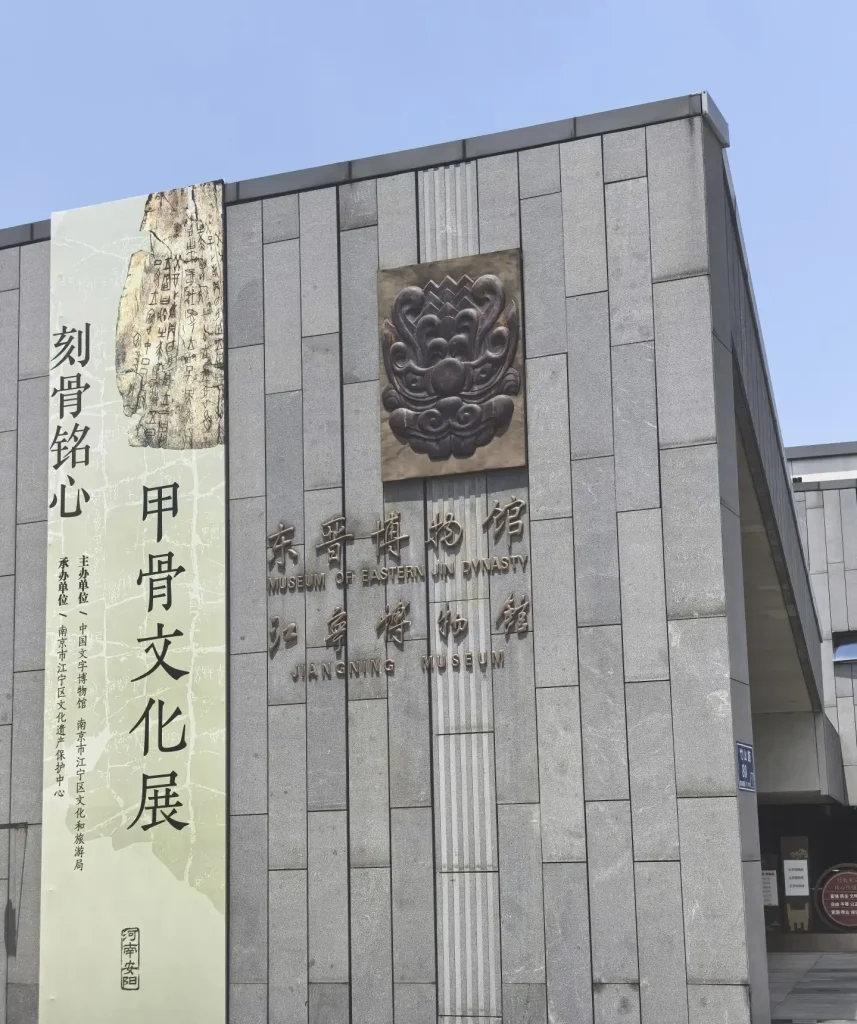
The Jiangning Museum is situated at No. 80 Zhushan Road, Dongshan Subdistrict, Jiangning District, Nanjing, on the banks of the Waigang River in Zhushan Park. It is the oldest state-owned museum within the district (county)-level cultural heritage system in Nanjing, having been established on 6 May 1958 and boasting a history of over sixty years. The museum site covers an area of 17.8 mu, with a total floor area of 7,480 square metres. The main building is a three-storey reinforced concrete structure. Its design draws inspiration from the distinctive platform-shaped foundation of the Huxu Culture, whilst incorporating the traditional Chinese cosmological concept of ‘the sky is round and the earth is square, with humanity and nature coexisting in harmony’. It harmoniously integrates mountains, water, the city and woodland into a single landscape. The main building, designed in an ancient architectural style, stands amidst lush greenery and clear waters, creating an exceptionally elegant and serene environment.
I. One Site, Two Museums: The Comprehensive History of Jiangning and the Splendour of the Eastern Jin Dynasty Side by Side
The museum adopts a ‘one site, two museums’ layout—a rarity in China—comprising two main areas: the Jiangning Museum and the Eastern Jin History and Culture Museum. The former systematically presents the historical evolution of Jiangning from prehistoric times to the modern era, whilst the latter is the country’s first specialised museum to comprehensively reflect the history and culture of the Eastern Jin Dynasty. The museum houses three permanent exhibitions—‘A Thousand Years of Jiangning’, ‘The Splendour of the Eastern Jin Dynasty’ and ‘The Pei Family’s Calligraphy and Painting Exhibition’—as well as a temporary exhibition hall. It is also equipped with a diverse range of functional spaces, including an academic lecture theatre, an intangible cultural heritage exhibition area, a 4D multi-purpose cinema, the ‘Bosutang’ cultural and creative shop, a pottery workshop, a sand painting experience area and a leisure reading area.
II. Highlights of the Collection: Treasures from the Neolithic Age to the Ming Dynasty
As of 2022, the Jiangning Museum’s collection comprises 8,370 artefacts and sets, of which 973 are classified as precious cultural relics. The collection spans an extensive chronological range, from the Neolithic Age through to the Ming and Qing dynasties, and includes items such as a Western Han Dynasty bronze cauldron, a Western Han Dynasty three-legged cauldron with an ox-head handle, a large jade bi disc from the Han Dynasty, Han-dynasty polychrome lacquer bowls, a land purchase certificate from the first year of the Tiance era of the Eastern Wu Kingdom, a Buddhist-style mirror from the Eastern Wu Kingdom, a rooster-headed jar and a frog-shaped water basin from the Eastern Jin Dynasty, a Song-dynasty celadon porcelain pillow, a Yuan-dynasty bronze weight, as well as a large number of bronze mirrors and ceramic funerary objects. The museum’s collection of Ming-dynasty artefacts is particularly valuable; items such as a gem-encrusted gold sutra case, a gold hair-binding crown and gold funeral currency are regarded as national treasures.
III. Core Exhibitions: Focus on Six Dynasties Celadon and the Elegance of the Eastern Jin
Among the numerous artefacts, Six Dynasties celadon constitutes the most distinctive category in the Jiangning Museum’s collection. Represented by the Yue Kiln, Six Dynasties celadon attained an artistic pinnacle described as ‘resembling ice and jade’, playing a pivotal role in bridging the past and the future in the history of Chinese ceramics. The museum’s collection of Six Dynasties celadon encompasses vessels such as jars, pots, cups, bowls, bowls, incense burners, censers, washbasins, ladles and candlesticks. Ranging from everyday storage and household items to banquet and wineware, tea sets for refined conversation, and the refined pastimes and calligraphy implements of the literati, these artefacts comprehensively reflect the prosperity of the agricultural economy during the Six Dynasties period, as well as the lifestyle and spiritual pursuits of the literati class. The museum’s collection of artefacts from the Eastern Jin Dynasty, such as the ‘chicken-headed’ jar and celadon spittoons, features a warm, lustrous glaze and simple, rustic forms, serving as precious evidence of the Jiangning Dragon Kiln site. The museum’s ‘The Elegance of the Eastern Jin’ exhibition hall is particularly ingenious: the introductory hall utilises a scroll-style projection, with seven scenes recreating the daily lives of renowned Eastern Jin literati such as Wang Dao, Xie An and Wang Xizhi. The exhibition hall is divided into four sections—tile ends, tomb inscriptions, gold and jade, and celadon—showcasing 86 Eastern Jin artefacts, including animal-mask-patterned tile ends and celadon chicken-headed jars.
IV. Historical Origins: Jiangning – The Fertile Heartland of Jinling Culture
Jiangning possesses an exceptionally rich historical and cultural heritage. This land is home to traces of ancient human activity dating back 500,000 years, stone and bone tools left by early inhabitants 8,000 years ago, the 4,000-year-old Huxu Cultural Site, and earthen mound tombs from the Spring and Autumn and Warring States periods dating back 3,000 years; 2,000 years ago, this was the fiefdom of a marquis; from 1,800 years ago onwards, it became the capital region of the ancient capital, Jinling. Since the founding of the People’s Republic of China, excavations of ancient sites and tombs within Jiangning have unearthed tens of thousands of cultural artefacts, and the Jiangning Museum serves as a vital custodian and showcase for this precious cultural heritage.
V. Visitor Information
The museum is situated at No. 80 Zhushan Road, Jiangning District, within Zhushan Park on the banks of the Qinhuai River. Admission is free to the public, and opening hours are Tuesday to Sunday, 9:00–17:00 (closed on Mondays). The museum organises special exhibitions and public education activities throughout the year, such as study programmes on Six Dynasties celadon and hands-on workshops recreating Eastern Jin-era ‘chicken-headed’ jars, allowing visitors to experience the charm of traditional craftsmanship through practical activities. For group bookings or enquiries, please call the museum’s service hotline.