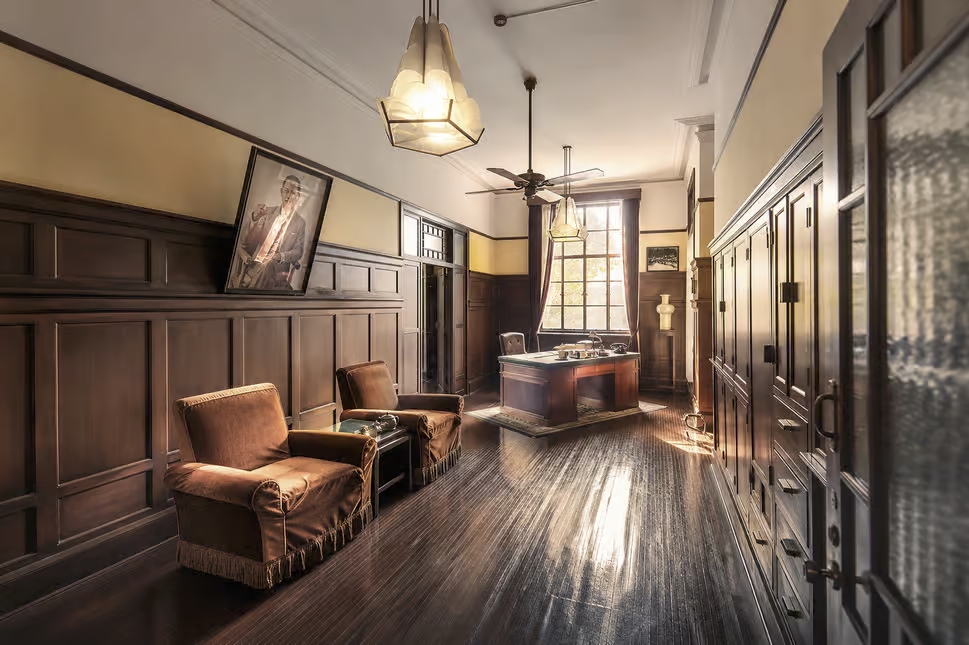
The Nanjing Presidential Palace is far from an ordinary historical building—it is a monumental “living chronicle of modern Chinese history” standing in the heart of Nanjing, aptly described by the well-known saying: “One Presidential Palace encapsulates half of modern Chinese history.” Located at No. 292 Changjiang Road, Xuanwu District, Nanjing, the site boasts a history spanning over 600 years, dating back to the early Ming Dynasty. Over the centuries, its identity has transformed repeatedly, layering six centuries of dynastic memory upon the same hallowed ground. It began as the residence of the Prince of Han during the early Ming Dynasty under Emperor Zhu Yuanzhang. During the Qing Dynasty, it served successively as the Jiangning Imperial Textile Factory, the Jiangnan Governor’s Office, and the Viceroy’s Office of Liangjiang (the Two Jiangs). Emperors Kangxi and Qianlong also used it as their temporary palace during their southern inspection tours. During the Taiping Heavenly Kingdom, Hong Xiuquan expanded it on a grand scale into the magnificent Heavenly Palace—the royal compound of the Taiping regime. In 1864, when the Heavenly Capital fell, the palace was ravaged by war, and the Qing court rebuilt the Viceroy’s Office of Liangjiang on the same site, where prominent late-Qing statesmen including Zeng Guofan, Li Hongzhang, Zuo Zongtang, and Zhang Zhidong once presided over military and civil affairs.
With the advent of the Republican era, this architectural complex became one of the central stages shaping the course of Chinese history. On January 1, 1912, Dr. Sun Yat-sen took his oath of office here as the Provisional President of the Republic of China, giving birth to Asia’s first republic. From then until 1949, the site successively housed the Jiangsu Provincial Governor’s Office, the Vice President’s Office, and the office of the National Government. In 1927, when the National Government formally established Nanjing as the capital, this became the nation’s administrative center. In 1948, following the implementation of the Constitution, the National Government was renamed the Presidential Palace, which remained in use until April 23, 1949, when Nanjing was liberated. Of particular note is the iconic cement gate tower built in 1929 in a neoclassical triumphal-arch style—its eight Ionic columns and three arched iron gates symbolize a break from the old order, while the traditional screen wall retained in front creates a striking fusion of East and West. After the founding of the People’s Republic of China, the Presidential Palace site served for decades as the office of the Jiangsu Provincial People’s Government and other government agencies. In 1998, preparations began to convert it into a museum, and by the end of 2000, all government offices had been relocated. Extensive restoration efforts were undertaken to revive its historical appearance.
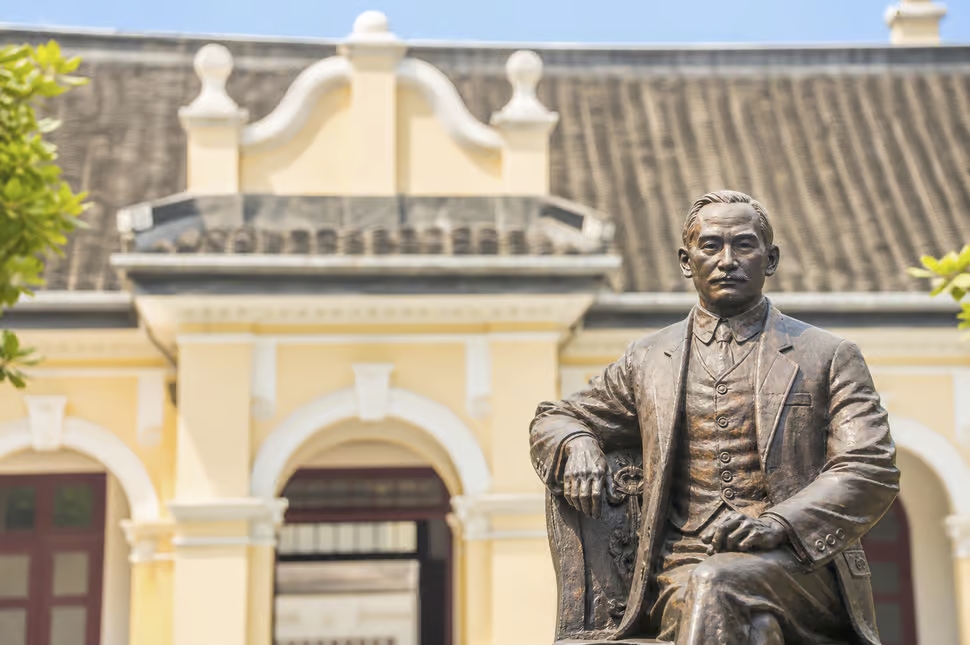
Today, the Presidential Palace covers an area of approximately 90,000 square meters and is laid out along three main visitor axes—central, western, and eastern—forming a magnificent compound that seamlessly blends traditional Chinese official architecture and garden design with modern Western architectural styles. It stands as one of the largest and best-preserved modern architectural complexes in China. The central axis was the core area of the National Government and the Presidential Palace, running from the gate tower through the Main Hall, the Second Hall, the Qilin Gate, and the Government Affairs Bureau, all the way to the five-story “Zilou Building”—named in memory of Lin Sen, Chairman of the National Government. Generalissimo Chiang Kai-shek’s presidential office was located in the southeast corner of the second floor. The Main Hall, originally the site of the Taiping Heavenly Kingdom’s Golden Dragon Hall, was rebuilt in 1870 by Zeng Guofan; it now features a prominent plaque inscribed with Dr. Sun Yat-sen’s calligraphy reading “Tian Xia Wei Gong” (The World Belongs to the People). Dr. Sun’s inauguration ceremony in 1912 took place in this very hall. The western axis is centered around the classic Jiangnan-style garden known as “Xuyuan” (the Rejoicing Garden), featuring such scenic spots as the “Unmoored Boat” stone pavilion, the Xijia Pavilion, and the Wangfei Pavilion. Dr. Sun Yat-sen’s Provisional Presidential Office and his residence are also located here, exuding quiet elegance. The eastern axis includes the Fuyuan (East Garden), the Executive Yuan Office Building, the stables, and the Taolin Er Gong Temple, among other historical relics. The Executive Yuan, as the highest administrative organ of the National Government, retains its well-preserved office scenes, offering a vivid glimpse into the period.
In 1982, the Presidential Palace was designated as part of the second batch of Major Historical and Cultural Sites Protected at the National Level under the name “Site of the Taiping Heavenly Kingdom’s Heavenly Palace.” In 2013, it was additionally included in the seventh batch of national-level protected sites under the designation “Dr. Sun Yat-sen’s Provisional Presidential Palace and the Architectural Heritage of the Nanjing National Government.” These honors underscore its irreplaceable historical value. Today, as the Nanjing Museum of Modern Chinese History and a national AAAA-level tourist attraction, the Presidential Palace is not only a premier destination for both domestic and international visitors seeking to understand China’s modern transformation but also the most important and iconic representative of Nanjing’s Republican-era architectural heritage. For those planning a visit, it is highly recommended to book tickets in advance through the official WeChat public account with real-name registration, and to allow at least three to four hours for a thorough exploration of the 600 years of historical drama and architectural beauty that this remarkable site has to offer.