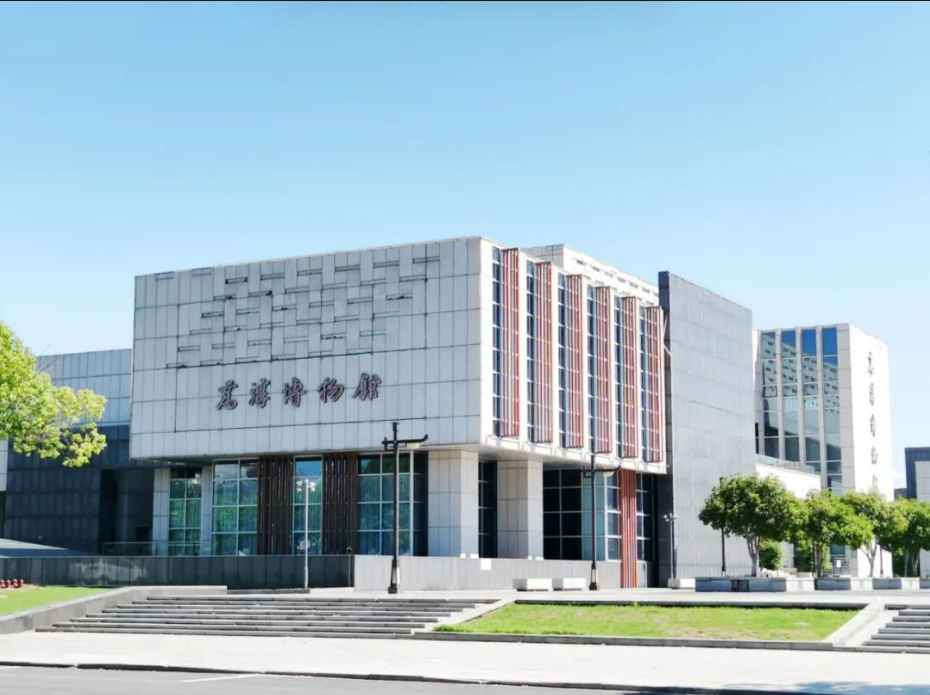
At the southernmost tip of Nanjing, in Gaochun District, the ancient Baosheng Temple Pagoda stands tall, watching over the land for centuries. Beside this thousand-year-old pagoda, a modern building sits as its neighbor—this is the Gaochun Museum, a comprehensive local museum dedicated to collection, research, exhibition, and education. In August 2024, the Gaochun Museum was elevated to National Second-Class Museum status, becoming the most worthy guardian and storyteller of Gaochun’s history and culture.
I. Museum Overview: A New Cultural Landmark Beside an Ancient Pagoda
The Gaochun Museum is located adjacent to the Baosheng Temple Pagoda Cultural Park, near the Baosheng Temple Pagoda, which was first built during the Three Kingdoms period under the Wu regime (circa 3rd century AD). The museum has a total construction area of 9,522.3 square meters, with nearly 3,000 square meters of exhibition space. It officially opened to the public on November 28, 2013. The museum houses 8,204 cultural relics (sets) , including 646 precious artefacts, encapsulating Gaochun’s civilization spanning from the Neolithic Age to the present day.
The museum features 3 permanent exhibition halls and 1 temporary exhibition hall. The core historical and cultural exhibition, themed “Lush Waters, Green Hills, Pure Folk Customs,” is complemented by the special exhibition “The Splendor of Laizhu: Bronze Casting History—Zhou Dynasty Bronzes Unearthed in Gaochun,” together forming a concentrated essence of Gaochun’s history, culture, and human ecology.
II. Core Exhibition: A 6,000-Year Civilization Unfolds
The museum’s permanent exhibition follows a chronological timeline, beginning with Gaochun’s earliest human habitation and tracing the threads of history through the ages.
Xuecheng Site: Nanjing’s Earliest Prehistoric Village
A large map of Gaochun’s ancient sites spreads across the exhibition hall, revealing the faces of primitive settlements and ancient cities from thousands of years ago. The life-scene reconstruction of the Xuecheng Site—known as “Jinling’s Earliest Ancient Village“—is the most captivating highlight. Over 6,000 years ago, the people of Xuecheng lived by the water, thriving on rice and fish. Visitors can view specimens of the rice, fish, clams, and other shellfish they consumed, along with production and daily-use tools such as stone axes, adzes, bone hairpins, and ceramic spinning wheels. Beneath towering “ancient trees,” the inhabitants hunt with primitive tools; outside a thatched hut, children help their mother light a fire for cooking—a vivid tableau of life from over 6,000 years ago, brought back to life.
The painted pottery jars, black-spotted jade bracelets, black pottery cups, and other artefacts on display are elegantly shaped. One particular black pottery cup features a specially crafted notch at the rim for drinking—a design that could well be considered fashionable even by today’s standards.
Ancient Engineering and Urban Memory
The exhibition also features a 1:1 scale replica of the “Xiaoguan Stele“—renowned as the “Foremost Stele South of the Yangtze River”—and presents life-scene reconstructions of Wu Zixu’s excavation of the Xu River (one of the world’s oldest artificial canals) and the ancient Gucheng City, which was built 208 years earlier than the Stone City of Nanjing. These vivid recreations allow visitors to trace the journey of ancient people from primitive settlements to the early walled cities of a more advanced society. In addition, there is a streetscape reconstruction of the historic Gaochun Old Street from the Republic of China era, featuring three representative shops that have become cherished memories for the older generation of Gaochun locals.
Daoist Deity Paintings and Regional Culture
The Gaochun Museum houses an exceptional collection of over 330 Daoist deity paintings from the Ming and Qing dynasties—a rarity in China. These works, divided into “divine scrolls” and “divine plaques,” reflect the folk customs and traditions of the Jiangnan region. A selection of 13 of these paintings is on display, offering a precious glimpse into Daoist cultural heritage.
Visitors can also learn about the Gaochun dialect, hailed as “a living fossil of ancient Chinese,” and see silver ingots from the Southern Song Dynasty inscribed with “exit tax” characters. From local customs to regional culture, the unique character of Gaochun is narrated, piece by piece, within the display cases.
III. Bronze Treasures: The Resonant Voice of Laizhu’s Bronze Age
On the museum’s first floor, the exhibition “The Splendor of Laizhu: Bronze Casting History—Zhou Dynasty Bronzes Unearthed in Gaochun” is on display. The name Laizhu dates back to the Spring and Autumn period—in 514 BC, King Yuji of Wu built Gucheng in Gaochun and established “Laizhu Yi” (the present-day Gucheng Site). Situated at the border of Wu and Chu, Gaochun was a key passage for the Wu state’s military campaigns against Chu.
The exhibition features 79 bronze artefacts from the Shang and Zhou dynasties, used for rituals, ceremonies, and warfare. With exquisite patterns, masterful craftsmanship, and distinctive styles, these bronzes hold great historical, scientific, and artistic value. Among them, four bronze swords from 2,500 years ago are particularly striking—two of them, remarkably, bear no trace of rust and remain sharp to this day. According to the curator, “a single gentle swing of a wooden stick could cut through with them.”
IV. Museum Highlights and Temporary Exhibitions
Beyond its 8,200-piece collection, the Gaochun Museum actively brings in high-quality exhibition resources. In July 2026, the museum signed a collaborative development agreement with the Nanjing Museum General Administration and launched the exhibition “Gleaming Gold and Radiant Jade: Gold, Silver, and Jade Artifacts from the Song and Ming Dynasties Unearthed in Nanjing,” featuring 119 precious artefacts on display. These pieces were mainly unearthed from tombs of prominent Song Dynasty families, Ming Dynasty nobles (including the Mu clan), and founding heroes of the Ming Dynasty. Together, they offer a complete picture of the aesthetic tastes of both dynasties—from the double-dragon-head gold bracelet weighing over 400 grams, excavated from the tomb of Mu Zan’s wife in the Ming Dynasty, to the silver ware discovered in the tomb of the son of Southern Song poet Zhang Xiaoxiang—each piece demonstrates the ingenuity and artistry of ancient craftsmen.
Previously, the museum also curated a series of original exhibitions, including “Farming and Scholarship: A Family Legacy—Calligraphy and Painting from the Museum Collection” and “In Search of Red Memories—Revolutionary Artefacts from the Museum Collection.”
V. Visitor Information
The Gaochun Museum is currently a National Second-Class Museum and is free and open to the public.
-
Address: Building 1, No. 7, South Shijiuhu Road, Chunxi Subdistrict, Gaochun District, Nanjing
-
Opening Hours: Tuesday to Sunday, 9:00 AM – 5:00 PM (closed on Mondays; holiday hours subject to separate notice)
-
Contact Number: 025-68616278
Gaochun Museum—beside an ancient pagoda, a chronicle of a region’s history. More than 6,000 years of civilization are distilled within its walls, waiting patiently for every visitor to turn the pages.