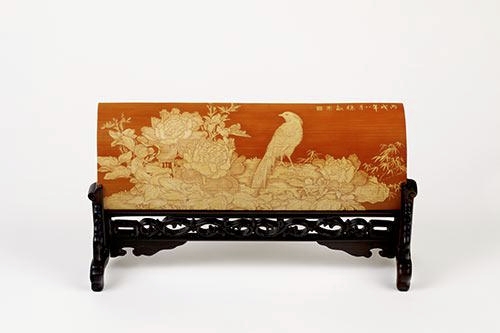
Jinling Bamboo Carving originated in the mid-to-late Ming Dynasty, blossoming over a span of nearly five hundred years into one of China’s most revered intangible cultural legacies. It is no ordinary handicraft passed down through workshops; rather, it stands shoulder to shoulder with Shanghai’s Jiading Bamboo Carving as the two supreme pillars of Chinese bamboo carving artistry – each a distinct universe of technique and taste, yet together defining the very canon of this refined art form.
What fundamentally distinguishes the Jinling school from its Jiading counterpart is its philosophical and aesthetic orientation. While Jiading carvers excel in bold, high-relief compositions and intricate deep openwork that dazzle the eye with their virtuosity and complexity, Jinling Bamboo Carving has, from its very dawn, been nurtured by the scholarly ethos of the Jiangnan region – a land of misty rivers, classical gardens, and a literary tradition that prized subtlety over ostentation. Jinling carvers embrace the principle of “simplicity that contains multitudes”: they wield their graving knives as a calligrapher wields his brush, favouring shallow incisions and delicate linework over deep excavation, seeking to capture the spirit and inner vitality of a subject rather than slavishly replicating its outward form. The technique of “retaining the green skin” (liuqing) – carefully preserving the bamboo’s thin epidermal layer to serve as a ground for engraved designs – allows the natural ivory-gold hue of the material to contrast with the darker, exposed fibre beneath, creating a painterly effect of light and shadow that feels almost like ink wash on silk.
In ancient times, these bamboo masterpieces were never mere ornaments. Scholars and literati would place them reverently upon their study desks, treating them as “elegant companions for the sleeve” and “treasured curios of the scholar’s studio” – objects to be contemplated during moments of quiet reflection, caressed and warmed by the palm during long nights of reading and writing. Through the tactile intimacy of handling bamboo, they found a tangible connection to the moral integrity it symbolised, giving life to the timeless adage: “Better to go without meat than to live without bamboo.” For these cultivated gentlemen, bamboo was not just a plant but a living metaphor for resilience, uprightness, and humble grace – and to carve it was to inscribe one’s own aspirations upon nature’s most honest medium. Every shallow stroke, every lingering cut, thus became a meditation on character, a calligraphic poem etched into the very soul of the material.
Fast-forward to the twenty-first century, and Jinling Bamboo Carving refuses to be a relic preserved under glass. While honouring the ancestral techniques passed down through some twenty generations – the precise angles of the knife, the subtle gradations of depth, the patient rhythm of polishing – the craft’s contemporary inheritors are boldly reimagining its possibilities. Under the energetic stewardship of the “Xuan Hao Wu” (Xuanwu Select) public brand – a flagship initiative of Xuanwu District dedicated to revitalising local heritage – these young artisans have infused the ancient art with fresh vitality. They have developed a delightful range of cultural and creative products that marry traditional charm with the sensibilities of modern daily life: delicately carved bookmarks that rest between pages like quiet poems, car hangers whose gentle bamboo fragrance accompanies every journey, scholarly paperweights that anchor the fleeting thoughts of a writer’s desk, and refined tea scoops that transform the simple act of brewing into a ritual of contemplation. Each piece retains the hallmarks of classical bamboo carving – the restrained elegance, the poetic emptiness, the dialogue between knife and grain – yet speaks a language that resonates with today’s aesthetic sensibilities.
What is truly remarkable is that these creations are no longer confined to museum vitrines or collectors’ cabinets. They have stepped gracefully into the everyday – into bustling urban homes, minimalist studios, and cosy tea houses – where they are touched, used, and cherished by people from all walks of life. In this way, Jinling Bamboo Carving has not merely survived; it has been reborn. It no longer speaks only to the secluded scholar of a bygone era but engages in a living, breathing conversation with contemporary culture. Through the quiet revolution of these modest yet exquisite objects, an ancient craft that once belonged to the rarefied world of literary elites has found its way into the hands of ordinary people, allowing the spirit of bamboo – resilient, upright, and ever-renewing – to take on a new lease of life in the modern world. And so, from the misty studios of Ming-dynasty Jiangnan to the vibrant streets of today’s Nanjing, the carving knife continues its unhurried dance, tracing the enduring bond between humanity and nature, between tradition and transformation, one graceful line at a time.