Jinniu Lake: Where the Fragrance of Jasmine Meets the Sails of Champions
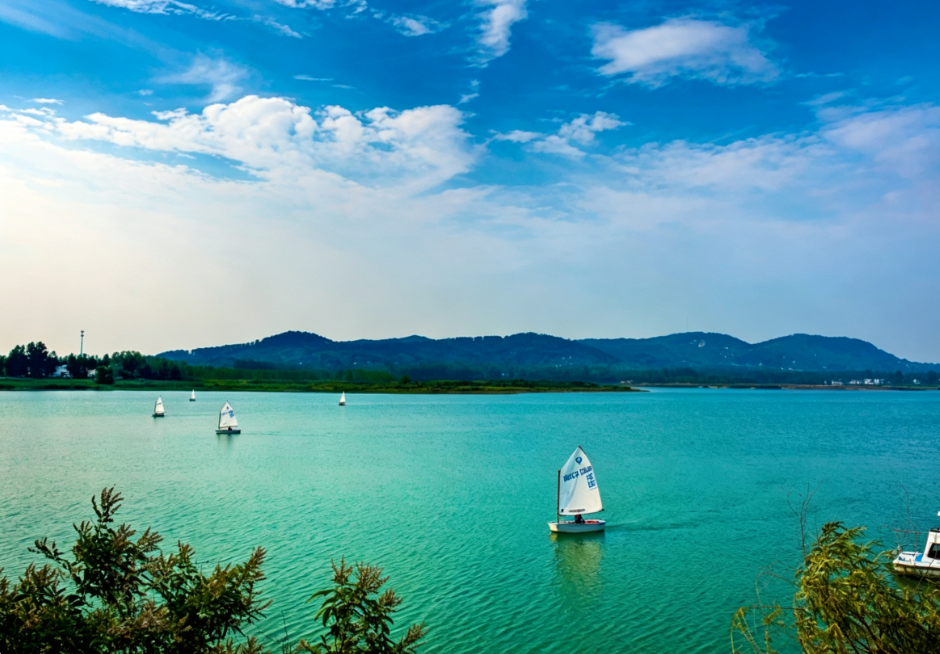
Jinniu Lake Scenic Area lies in the northeastern part of Liuhe District, Nanjing, at the junction of Jiangsu and Anhui provinces. It is a National AAAA-level Scenic Spot, a National Water Conservancy Scenic Area, a core attraction of the National Geopark, a Provincial Tourist Resort, and a Provincial Forest Park. As the largest artificial lake in Nanjing, Jinniu Lake covers a water area of approximately 25,000 mu (about 1,667 hectares) and holds a storage capacity of over 90 million cubic meters—a gleaming jade embedded among surrounding peaks. The lake takes its name from the adjacent Jinniu Mountain (Golden Ox Mountain), which rises 196 meters above sea level and resembles a recumbent ox drinking from the water—its head, nose, and tail vividly formed. At the foot of the “ox’s nose,” a spring flows ceaselessly throughout the year, creating a picturesque landscape of “mountains embracing water and water reflecting mountains.” The scenic area boasts 5,000 mu of forest cover, with a vegetation coverage rate as high as 96%. Towering pines, cypresses, and metasequoias intermingle with maple trees, Chinese toon, and wild bamboo groves, providing a habitat for nearly a hundred species of wildlife, including hares, pheasants, and egrets. It is renowned as a “natural oxygen bar” and the “Finest Scenery North of the Yangtze River.”
I. The Birthplace of Jasmine Flower: A Folk Song That Resonates Around the World
Jinniu Lake is the birthplace of the world-famous Jiangsu folk song Jasmine Flower (Mo Li Hua). In the winter of 1942, He Fang, a cultural corps soldier of the New Fourth Army, was collecting folk songs in the area of Bashanqiao Town near Jinniu Mountain. From a local folk artist, he heard a traditional melody called Xianhua Diao (Flower Tune), which consisted of three verses praising the jasmine, honeysuckle, and rose respectively. In 1957, He Fang adapted the song, combining the three flowers into a single tribute to the jasmine, thus giving birth to the beloved Good Jasmine Flower. In 1982, UNESCO recommended the song as one of the world’s outstanding folk songs, making it one of China’s most internationally recognized melodies. Today, a commemorative monument and a historical archives hall have been erected within the scenic area, allowing visitors to trace the story behind this classic folk song.
II. Olympic Glory: Sailing Competitions on Azure Waves
With its expansive, clear waters and stable hydrological conditions, Jinniu Lake provides an ideal natural venue for water sports. In 2014, the sailing competitions of the Nanjing Youth Olympic Games were held here, leaving behind the prestige of a world-class sporting event and establishing Jinniu Lake as the Youth Olympic Sailing Base. Since then, the base has continued to operate, hosting multiple high-profile regattas, including the National Youth Sailing League and the Grand Canal Sailing Series. In June 2026, the Grand Canal Sailing Series (Nanjing Jinniu Lake Station) and the Nanjing Sailing Open were held here, with teams from every province with active sailing programs participating. More than 260 young athletes competed on the azure waves, their colorful sails dotting the lake against the backdrop of mountains and water—a dynamic spectacle that perfectly captures the spirit of “where the fragrance of jasmine meets the sails of champions.”
III. Imperial Legends and Ancient Temple Chants
Jinniu Lake is steeped in rich folklore. According to legend, Zhu Yuanzhang, the founding emperor of the Ming Dynasty, herded cattle here for his uncle “Xu Bainiu” during his youth. One day, he and his companions secretly slaughtered one of his uncle’s oxen and placed its head and tail at opposite ends of the mountain, claiming that the ox had burrowed into the mountain. From then on, the entire mountain gradually took on the shape of a recumbent ox—hence the name Golden Ox Mountain. As you wander through the hills, you can almost hear echoes of this future emperor’s humble boyhood.
At the summit stands the Jinguang Temple (Golden Light Temple), originally built during the Wanli period of the Ming Dynasty (1573–1620) under the name “Taishan Xinggong Shengmuyuan.” With a history of over 400 years, the temple’s main structures include the Hall of Heavenly Kings, the Grand Hall, and the Guanyin Hall—all imposing in scale. Inside, solemn Buddhist statues, curling incense smoke, and the resonant chanting of sutras create an atmosphere of profound serenity. From the temple’s observation platform, visitors can gaze far into the distance, taking in a panoramic view of Jinniu Lake—the lake shaped like a deer antler, its emerald waters embraced by encircling peaks, where sky and water merge into one. At the foot of the mountain, more than a dozen naturally formed scenic spots—such as the Golden Turtle Exploring the Sea, the Divine Fish Playing in the Water, and the Lovers’ Stone—offer endless visual delights.
IV. Wildlife Kingdom: China’s First Quarry-Themed Safari Park
Adjacent to Jinniu Lake Scenic Area lies the Nanjing Jinniu Lake Wildlife Kingdom, China’s first wildlife park integrating mountainous terrain, mining pits, and open quarries. Covering 1,608 mu and sheltering nearly 300 species of domestic and exotic wildlife, it is also an AAAA-rated scenic area. Through ecological restoration, the park has transformed abandoned quarries and mining pits from the local Ye Mountain area into exclusive habitats for wild animals, creating an immersive wilderness experience. Visitors can drive or take a sightseeing train through the “Grassland Tribe” zone, observing lions, tigers, zebras, and giraffes up close; stroll through “Crocodile Canyon” to admire crocodiles from around the world; walk through “Bird Paradise” to hear the chorus of hundreds of birds; or visit the “Animal Carnival” area to feed gentle dwarf horses and alpacas—an activity particularly beloved by families with children. The glass-bottomed footbridge suspended atop the mountain is a highlight—beneath your feet lie the quarries with roaming wildlife and echoing roars; before you unfolds the signature view of Jinniu Lake, with its “golden ox reclining on the waves” and vast forests mirrored in the water, offering an awe-inspiring and refreshing experience.
V. Lakeside Cuisine and Leisure Activities
Jinniu Lake Scenic Area is renowned for its “Jinniu Lake Feast,” which blends the culinary traditions of Jinling and Liuhe. The distinctive farmhouse dishes and fresh lake fish leave a lasting impression on every visitor. An annual Food and Cultural Tourism Festival is held at the end of the year, drawing crowds eager to sample the local delicacies. In recent years, the scenic area has developed a range of diverse leisure offerings, including water sports camps, jungle off-road karting camps, and “Fir and Water” tent camping sites. The lakeside market and themed events such as “Sailor’s Night” add to the vibrant atmosphere. Whether cycling around the lake, taking a boat cruise, enjoying a lakeside picnic, or camping under the stars, visitors can fully immerse themselves in the beauty of mountains and water. The extensive tea plantations on the northern slopes and the Jinniu Mountain Battle Monument—a site of revolutionary history—add further layers of historical depth to the area.
Jinniu Lake—from imperial legends to the melody of Jasmine Flower, from Olympic glory to a wild animal kingdom—offers every visitor an unforgettable memory of Jinling, woven from its unique natural endowments and rich cultural heritage.