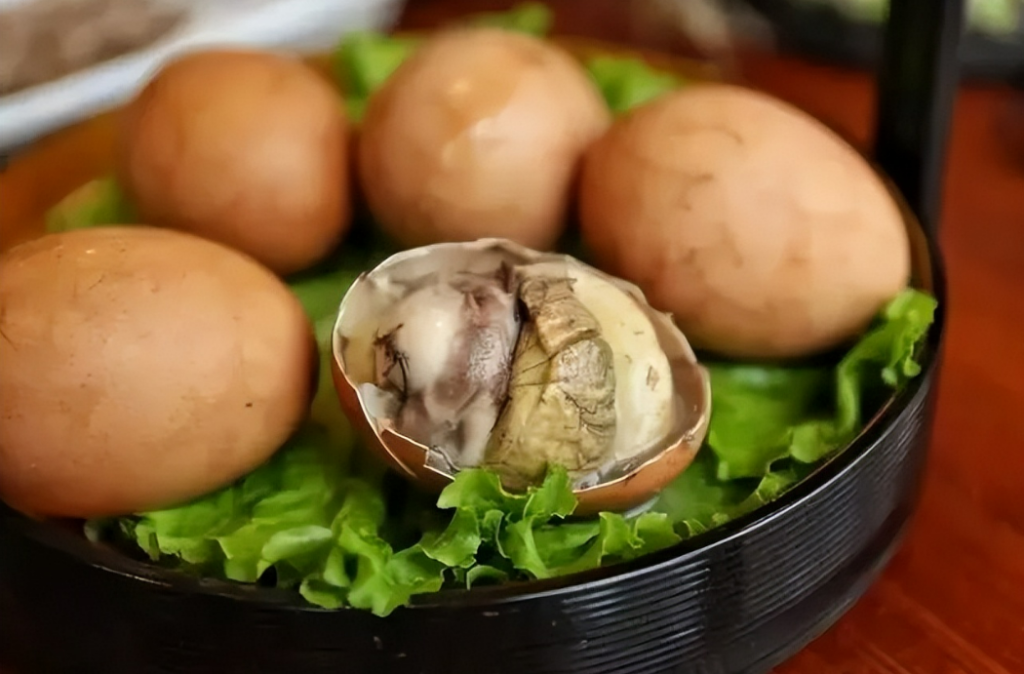
On Nanjing’s vibrant culinary canvas, few delicacies spark as much intrigue—and sheer fascination—as the “Live Pearl” (Huo Zhu Zi). This is not merely a snack; it is a centuries-old tradition, a test of gastronomic courage, and perhaps the most extraordinary expression of Nanjing’s relentless pursuit of freshness.
The Art of Incubation: Nature’s Perfect Timing
Far from an ordinary egg, the Live Pearl is a carefully incubated chicken embryo, harvested at the precise window of twelve to fourteen days—a moment of biological perfection when the embryo has begun to take form yet remains enveloped in its original liquid richness. At this stage, the developing chick has not yet developed bones or feathers, existing instead as a translucent, pearl-like orb suspended in a pool of natural broth. The name “Live Pearl” derives from this visual poetry: the embryo, nestled within the egg white, gleams like a precious jewel cradled in a silken embrace. The incubation process is an art in itself, requiring meticulous temperature control—hovering around 37.5°C—and exact humidity levels, with skilled artisans turning the eggs multiple times daily to ensure even development. The result is a delicacy that cannot be replicated by mass production; each batch represents a delicate dance between nature and human craftsmanship.
The Ritual of Savoring: A Three-Act Sensory Journey
Savoring this “folk elixir” follows a time-honored ritual that transforms eating into a contemplative ceremony:
Act I: The Awakening Sip — Gently tap the wider end of the shell with a small spoon or your fingers, creating a modest opening. Tilt your head back and let the warm, crystalline broth flow onto your tongue. This “embryonic nectar” is unlike any soup you’ve ever tasted—a clear, golden liquid imbued with an umami so profound and pure it seems to awaken every taste bud at once. Its flavor is delicate yet complex, carrying subtle notes of chicken essence mingled with an indescribable freshness that speaks of life itself. Connoisseurs believe this broth holds the very essence of the egg’s vitality.
Act II: The Textural Revelation — After the broth comes the main event. Gently peel away the remaining shell to reveal the egg white, now firm yet tender, encasing the developing embryo. Dip it lightly in a pinch of fine salt and Sichuan pepper—or, for the purist, enjoy it unadorned. The first bite offers a revelation of textures: the albumen is delicately resilient, the yolk creamy and rich, and the tiny embryo itself—barely the size of a thumbnail—presents an intriguing firmness that yields to a subtle, meaty savoriness. Each mouthful offers a delightful interplay of softness and gentle chew.
Act III: The Lingering Finish — The final piece, often the small, darker mass at the tip where the embryo’s head has formed, delivers the most concentrated essence of flavor. Some diners save it for last, savoring it slowly as the satisfying climax of the experience. A final sip of tea or a bite of pickled ginger cleanses the palate, leaving behind nothing but the memory of an extraordinary culinary encounter.
A Delicacy of Courage and Discernment
Let it be clearly understood: the Live Pearl is worlds apart from the so-called “rotten eggs” or “dead embryos” that have given this category of food a questionable reputation elsewhere. Those are eggs where incubation has failed, where the embryo has perished and decomposition has begun—a truly unpalatable and potentially hazardous affair. The Live Pearl, by contrast, is a live, healthy embryo, carefully monitored and consumed at its peak of freshness. The difference is as vast as night and day, and Nanjing locals are quick to educate the uninitiated on this crucial distinction.
In Nanjing, consuming Live Pearls is not merely about sustenance—it is a rite of passage, a badge of local identity. Street vendors have been selling them for generations from steaming cauldrons at dawn, their calls echoing through misty alleyways. Elderly aunties deftly crack shells with practiced precision, handing them to eager customers on the morning commute. For many Nanjing natives, the taste of Live Pearl is intertwined with childhood memories—of grandparents carefully preparing the eggs, of bustling morning markets, of a city waking to the aroma of simmering broth. To eat a Live Pearl is to participate in a living tradition that has connected generations of Nanjing residents to their culinary heritage.
Beyond the Bite: Nutritional Lore and Modern Revival
Traditional Chinese dietary culture holds the Live Pearl in high esteem, believing it to be rich in essential amino acids, proteins, and bioactive compounds. It is sometimes prescribed as a restorative tonic for the frail or convalescent, earning it the affectionate nickname “the poor man’s ginseng.” Modern nutritional analysis has confirmed that the embryo at this stage contains higher levels of certain nutrients than a regular egg—including lecithin, taurine, and a full spectrum of B vitamins—though, as with all delicacies, moderation remains the wise course.
In recent years, this ancient snack has experienced a renaissance. Upscale restaurants in Nanjing have begun incorporating Live Pearls into innovative tasting menus, pairing them with delicate wines or presenting them on custom ceramic spoons alongside edible flowers. Yet for all its newfound gourmet prestige, the most authentic experience remains the simplest: standing at a street-side stall, egg in hand, steam rising into the cool morning air, joining generations of Nanjing gourmands in a timeless ritual of courage, culture, and pure, unadulterated flavor.