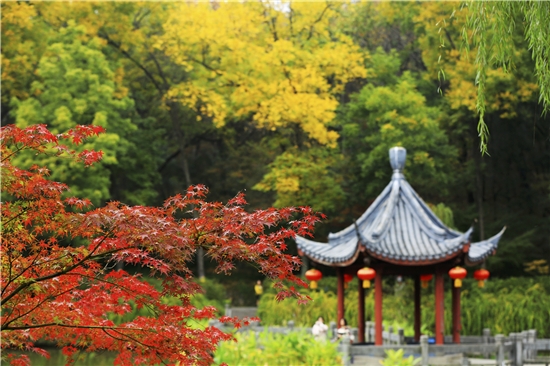
Qixia Mountain is situated in Qixia District, Nanjing. It is one of the ‘Forty-Eight Scenic Spots of Jinling’ and has long been renowned for the saying, ‘One Qixia Mountain, half the history of Jinling’; it is also one of China’s four premier destinations for viewing autumn foliage. Its distinctive features can be summarised in three points: maple leaves, historical sites and Buddhist culture.
Autumn at Qixia: One of China’s Four Premier Destinations for Viewing Autumn Foliage
Qixia Mountain is most famous for its autumn foliage. Every year from late October to mid-to-late November, the mountain’s forests are ablaze with colour, as species such as sweetgum, red maple and Japanese maple transform the entire mountain into a tapestry of red, orange and yellow. The areas around Taixu Pavilion, Taohua Lake and Fenglin Lake are widely recognised as the best vantage points for viewing the foliage. Every autumn, the scenic area hosts the ‘Red Maple Festival’, a must-visit event for Nanjing residents during the season.
Millennia-Old Temples and Historical Sites
The centrepiece of the mountain is Qixia Temple, founded during the Southern Dynasties. It is one of the few renowned ancient temples from the ‘480 temples of the Southern Dynasties’ to have survived to this day and remains a thriving place of worship. The Relic Pagoda beside the temple is a stone pagoda from the Southern Tang period, featuring exquisite carvings; Behind the temple lies the Thousand Buddha Caves, which house hundreds of stone Buddha statues and are hailed as the ‘Yungang of Jiangnan’; the largest of these caves enshrines a statue of the Buddha of Infinite Life standing over ten metres tall. Furthermore, the mountain is home to historical sites such as the Sui Pagoda (originally built during the Sui Dynasty, though the current structure is a modern reconstruction) and the Emperor Qin’s Viewing Point (where, according to legend, Emperor Qin Shi Huang once stood to gaze out over the Yangtze River).