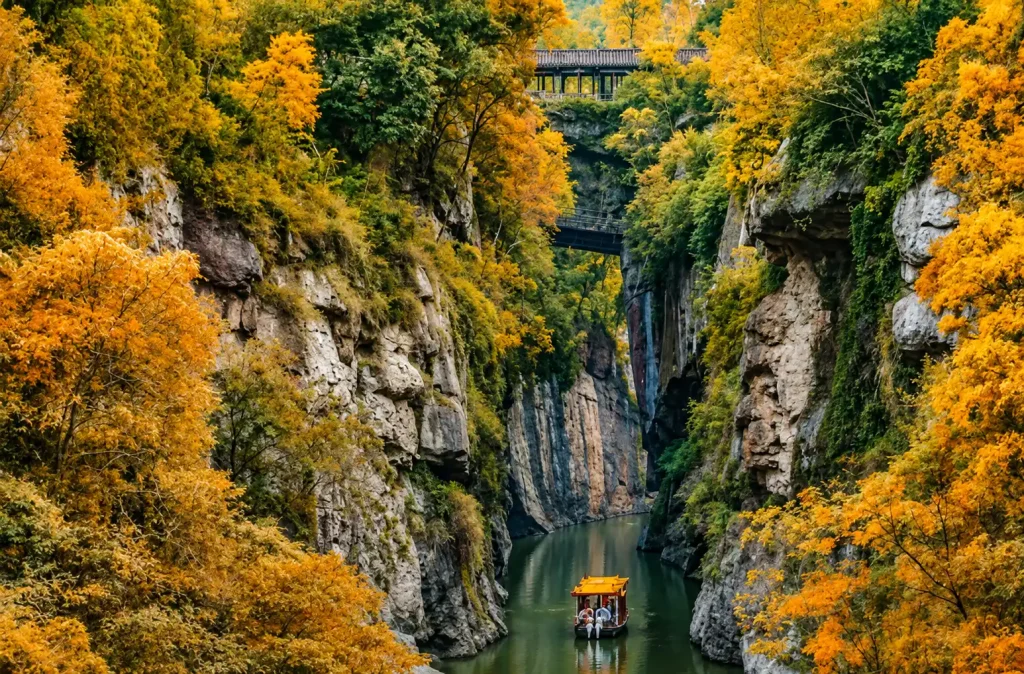
Approximately 4 kilometers west of Lishui District in Nanjing, a remarkable waterway winds its way through the rocky hills—the Yanzhi River (Rouge River). Spanning across the river stands a colossal natural stone arch bridge—the world-famous Tianshengqiao (Natural Stone Bridge) , the most renowned historical attraction in Lishui.
I. Man-Made “Masterpiece of Nature”: The Origin of Yanzhi River and Tianshengqiao
During the Hongwu reign of the Ming Dynasty, after establishing Nanjing as his capital, Emperor Zhu Yuanzhang ordered the construction of an artificial canal to connect the Qinhuai River with the Taihu Lake water system, in order to improve water transport and relieve the bottleneck of shipping grain and taxes from the southern Jiangsu region to the north. This colossal project officially commenced in the 26th year of the Hongwu reign (1393) , under the supervision of Marquis Li Xin of Chongshan. Over hundreds of thousands of laborers were conscripted, and the project took more than ten years to complete, finally carving out the 7.5-kilometer-long Yanzhi River.
The excavation of Yanzhi River stands as a miracle of Ming Dynasty hydraulic engineering. The waterway had to pass through rocky ridges tens of meters high, yet with no gunpowder available at the time, the craftsmen employed the method of “burning and dousing“—heating the rocks with intense flames and then splashing them with cold water. This thermal expansion and contraction caused the rocks to fracture, which were then removed by manual labor. Over the course of more than a decade, hundreds of thousands of laborers, armed only with the most primitive tools, chiseled their way through what could be called the “Qinling Mountains of Jiangnan.”
When the canal reached the middle section of the rocky ridge, the workers encountered a formidable challenge—the hardest rock strata lay directly in their path. The chief engineer, Li Xin, chose not to blast through it completely but instead deliberately reserved a massive natural stone arch spanning the river, creating a “heaven-born bridge” connecting the two banks, with the river flowing beneath it. Thus, Tianshengqiao (Natural Stone Bridge) came to be—not a product of nature alone, but a wonder “preserved” by the wisdom of ancient craftsmen.
The Yanzhi River stretches for 15 li (approximately 7.5 kilometers), with a width of 20 to 30 meters, flanked by sheer stone cliffs rising 30 to 50 meters. The Tianshengqiao is approximately 34 meters long, 9 meters wide, and 8 meters thick, with its deck standing about 36 meters above the river. Two modern bridges—the Rainbow Arch Bridge and the Suspension Bridge—stand nearby, creating a fascinating spectacle of “bridges above bridges and bridges below bridges.” Upon the project’s completion, the chief designer Li Xin composed a poem: “Two cliffs face each other like stone gates, untouched by dust through ages untold. Hills still green and water still clear, nature’s portal connects to heaven’s fold.” These lines capture the breathtaking majesty of the “natural aperture” that is Tianshengqiao.
In April 1995, Tianshengqiao was designated as a Jiangsu Provincial Cultural Relic Protection Site. With its spectacular scenery, it has earned the reputation of the “Little Three Gorges of Jiangnan.”
II. The Legendary Hue of Yanzhi River: The Timeless Mystery of “Rouge on Stone”
The color of the Yanzhi River is one of its most legendary features. During the transition from spring to summer, or after rainfall under specific lighting conditions, the entire river takes on a faint reddish hue, like rouge on a young maiden’s cheeks—a sight that never fails to astonish visitors. Two distinct explanations exist for this phenomenon:
-
Folk Legend: During the excavation of the Yanzhi River, hundreds of thousands of laborers worked day and night on the rocky ridges. Countless workers perished from exhaustion, accidents, and disease. Their blood and sweat mingled with the rocks, staining the entire river with the color of rouge—a lingering trace of sacrifice. This legend adds a poignant, human dimension to Tianshengqiao.
-
Scientific Explanation: The cliffs flanking the Yanzhi River are primarily composed of hematite and limonite, with extremely high iron content. Over centuries of weathering, erosion, and rainwater runoff, these reddish-brown minerals have continuously dissolved into the river. Particularly during summer high temperatures or after flood seasons, the increased concentration of iron ions imparts the river with its distinctive reddish tint.
Whether viewed through legend or science, the name and color of the Yanzhi River have become inseparable from the identity of Tianshengqiao.
III. Cruising the River: A Painted Journey Through the “Little Three Gorges”
The best way to experience Tianshengqiao is to take a traditional painted pleasure boat on the Yanzhi River. As the boat glides slowly through the arch of Tianshengqiao, threading between the sheer cliffs on both sides, you find yourself beneath a massive stone bridge overhead and flowing emerald waters beneath your feet, while the red cliffs unfold like a painted scroll on both sides.
Looking up, you can see that the bridge deck is 8 meters thick, appearing like a colossal stone slab suspended in midair. As your boat passes beneath the bridge, you can see the chisel marks left by artisans 600 years ago—each mark a testament to the arduous labor of the “burning and dousing” era.
The cliffs on both sides rise precipitously, their rock layers displaying rich hues of reddish-brown and ochre yellow. In the interplay of sunlight and water, the layers take on vivid clarity and majestic grandeur. Along the way, you can observe natural wonders such as the “Coiled Dragon Stone,” “Dragon Wall Cliff,” and “Crouching Tiger Rock,” which blend seamlessly with the ancient engineering marvels. The river journey along approximately 7.5 kilometers of waterway takes about 30 to 40 minutes. The sound of flowing water and a gentle breeze create the sensation of “traveling within a painting.”
IV. Tianshengqiao’s Other Perspective: Bridge-Top Views and the Poetry of Yanzhi River
Beyond the boat tour, visitors can also walk across Tianshengqiao itself to overlook the Yanzhi River from above. Standing on the 9-meter-wide bridge deck, you gaze down at the deep river valley and the emerald water below, with layered red cliffs stretching on both sides—a view both grand and spectacular. In the distance, green mountains rise like dark eyebrows, and fields crisscross in orderly patterns, presenting a tranquil scene of Jiangnan’s rural charm.
Within the scenic area, there is also the Phoenix Well, which legend says was dug by Emperor Zhu Yuanzhang to reward the laborers who built the canal. Gardens and leisure zones integrate natural scenery with historical sites. With lush forests throughout the area, a stroll here offers both a sense of historical depth and the peace of nature.
V. A Hydraulic Monument of Ming Culture: Tianshengqiao’s Historical Significance
Tianshengqiao is more than just a scenic attraction—it stands as an outstanding representative of Ming Dynasty hydraulic engineering and bridge construction. The Yanzhi River project it spans was one of the most crucial infrastructure projects in the early Ming urban development of Nanjing, ranking among the greatest achievements in the history of ancient Chinese man-made canals.
The 7.5-kilometer Yanzhi River not only completed the “last mile” of water transport between Jiangsu and Zhejiang provinces but also played an irreplaceable role in the supply and economic development of Nanjing. To this day, the Yanzhi River remains a vital water conservancy hub for the Lishui area. Tianshengqiao, with its design concept of “spanning the river with a stone bridge,” demonstrates the exceptional engineering wisdom and aesthetic pursuit of ancient craftsmen.
In 2013, Tianshengqiao was rated as a National AAA-Level Tourist Attraction, and in January 2024, it was designated as a National Water Conservancy Scenic Area, joining Zhongshan Reservoir and Fangbian Reservoir in Lishui District as one of Jiangsu Province’s 45th and Nanjing’s 4th national water conservancy scenic areas.
VI. Visitor Information
-
Address: No. 500 Tianshengqiao Avenue, Lishui District, Nanjing
-
Ticket Fee: Admission is charged (please check current prices at the entrance or through official channels in advance).
-
Recommended Visit Duration: Approximately 2 to 2.5 hours (including boat tour and walking)
-
Best Seasons: All seasons are suitable—the river’s color is most striking after spring-summer rainfall; autumn offers clear skies and vibrant foliage; and during the Spring Festival period, the scenic area hosts the Qinhuai Source Lantern Festival.
-
Getting There: Self-driving or local Lishui public transport is recommended—simply navigate to “Tianshengqiao Scenic Area.”
Tianshengqiao—half the legacy of ancient craftsmen from 600 years ago, and half the natural wonder of red cliffs carved by nature over eons. By the banks of the Yanzhi River, beneath the Natural Stone Bridge, history and nature converge to create Nanjing’s most unique “Little Three Gorges of Jiangnan.” Whether you are a history enthusiast, a photography lover, or a family traveler, this place will not disappoint—take a painted boat through the red cliffs, and you will touch the epic engineering saga of the Great Ming Dynasty.