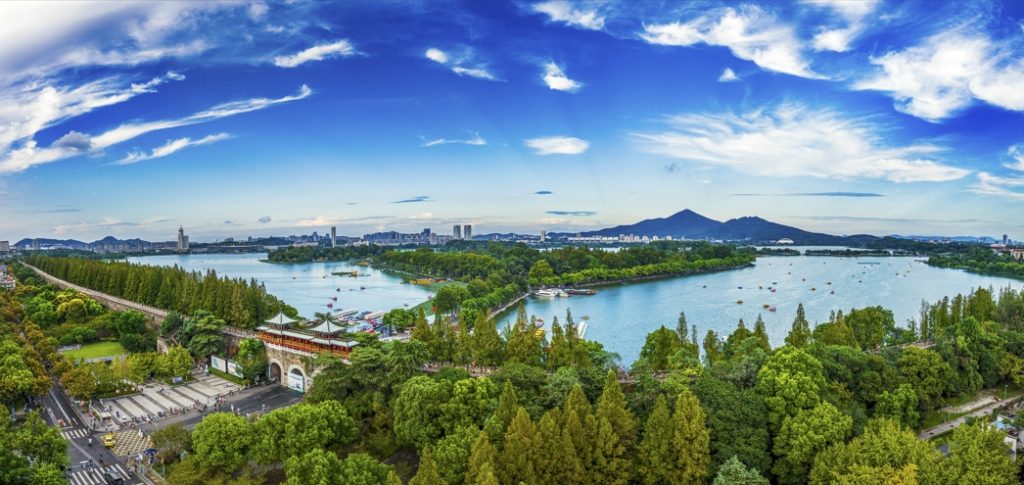
I. Historical Depth: From a ‘Military Training Ground’ to an ‘Imperial Garden’
The history of Xuanwu Lake has run almost parallel to that of Nanjing itself. Its origins can be traced back to the Pre-Qin period, when it was known as ‘Sangbo’ and was merely a marshy wetland at the mouth of the Qinhuai River where it flows into the Yangtze. During the Three Kingdoms period, Sun Quan of the Eastern Wu dynasty designated it as a naval training base, naming it ‘Lianhu’ (Training Lake), where warships once cut through the waves and set sail. In the Six Dynasties period, it was formally elevated to the status of an imperial reserve and renamed ‘Houlü’ (Rear Lake) or ‘Beihu’ (North Lake); Emperor Wen of the Song Dynasty once held a grand naval review here, a spectacle of immense grandeur. During the reign of Emperor Wu of the Southern Qi Dynasty, naval manoeuvres on the lake inspired the verse: ‘The jade water clock ticks away in Xuanwu Lake’. By the Ming Dynasty, Zhu Yuanzhang had established Nanjing as the capital and designated Houhu as a ‘national archive’—the Huangceku—where household registration and tax records from across the country were centrally stored. The islands within the lake became a heavily guarded restricted area, off-limits to ordinary citizens. It was not until the late Qing dynasty that Xuanwu Lake gradually opened its arms to the public, completing a magnificent transformation from imperial private property to a people’s park. Today, a sign marking the ‘Ruins of the Huangce Repository’ still stands in the lake, recounting the bygone era when ‘all the wealth of the realm was stored within a single lake’.
II. The Charm of the Five Islands: Each Island, a Unique Scene; Every Step, a Lotus Blossom
The five islands of Xuanwu Lake are not arranged haphazardly, but ingeniously draw upon the classical Chinese garden principle of ‘one pond, three hills’, whilst forming a style all of their own.
Huanzhou (the Central Island): Shaped like a jade ring and surrounded by water on all sides, it is the largest of the five islands and boasts the most expansive scenery. The island is densely planted with weeping willows; when a gentle breeze blows, they resemble strands of jade silk, hence its name ‘Huanzhou’s Misty Willows’. At the eastern end of the island stands Guo Pu’s Mound—the symbolic tomb of Guo Pu, the great literary figure of the Eastern Jin dynasty and the founder of feng shui. With its rustic stone steps and lush evergreens, it is a frequent destination for literati and poets who come to pay their respects. The ‘Guo Pu Pavilion’ atop the mound, with its upturned eaves, offers the finest vantage point from which to overlook Lianhua Harbour.
Cherry Island (Island of Flower Seas): Nestled within the embrace of the surrounding islets, it takes its name from the cherry trees that once covered its slopes. Every year from late March to early April, thousands of cherry blossom trees on the island burst into bloom, their pink and white blossoms resembling clouds or snow. As the petals drift onto the lake’s surface and float with the current, they create one of Nanjing’s most romantic springtime scenes. At the southern end of Cherry Island lies the ‘Cherry Island Corridor’, with its intricately carved beams and painted rafters. Calligraphy and painting exhibitions are frequently held within the corridor; sitting leisurely beneath it, watching the falling blossoms, evokes the feeling of ‘wandering through a painting’.
Liangzhou (Island of Autumn Colours): This is the island with the richest cultural heritage among the Five Islands, named after Prince Zhaoming of the Liang Dynasty of the Southern Dynasties, Xiao Tong, who once built the ‘Liang Garden’ here to study. The island is home to the Lansheng Tower, from which one can take in the panoramic view of the entire lake; whilst the ruins of the Lake God Temple are steeped in legend—it is said that Zhu Yuanzhang once offered sacrifices to the Lake God here to pray for favourable weather and bountiful harvests. The most enchanting season is autumn, when the island’s century-old ginkgo grove turns a brilliant gold and the fallen leaves form a thick carpet on the ground, complementing the crimson maples and Chinese tupelo trees to create a scene that has earned it the title of ‘Jinling’s Premier Island for Autumn Colours’. Every autumn, Liangzhou also hosts a grand chrysanthemum exhibition, featuring hundreds of varieties and tens of thousands of pots arranged in various formations, their fragrance filling the air.
Cuizhou (Island of Seclusion): Situated at the easternmost tip of the Five Islands, it takes its name from the lush green bamboo that covers the island, remaining evergreen throughout the seasons. Cuizhou is the most tranquil of the islands, with dense woodland and winding paths leading to secluded spots. The Cuizhou Tea House stands here, its white walls and dark-tiled roof nestled amongst the bamboo groves. In the early morning, it is common to see elderly people practising Tai Chi or warming up their voices here; in the afternoon, one might order a pot of Yuhua tea, sit by the window and watch the pleasure boats glide gently across the lake, as if time itself had slowed by half a beat. Cuizhou is also a paradise for birdwatchers; in winter, flocks of cormorants and wild ducks can be seen resting amongst the reed beds.
Lingzhou (Island of Childhood Delights): Situated in the south-eastern corner of the lake, it takes its name from its abundance of water chestnuts. Lingzhou was once the site of Xuanwu Lake’s ‘zoo’ (the zoo has since been relocated to Hongshan), but the island still retains its open lawns and playground facilities, making it a favourite with families with children. On the western side of the island stands Lingzhou Pier, from where you can board a boat to cruise the lake and admire the lotus and water lilies up close.
The five islets are linked by long embankments and arched bridges, such as the Cuihong Embankment, the Ring Lake Embankment and Lingzhou Bridge. Strolling along them, with the open lake on one side and the lush islets on the other, the scenery changes with every step, offering endless delight.
III. From the Top of the City Walls: A Masterpiece of ‘Mountains, Water, City and Forest’ as Seen from Tai Cheng
The Ming Dynasty city walls at Tai Cheng are the soulful counterpart to Xuanwu Lake. Construction of this section of the city wall began during the Hongwu era of the Ming Dynasty, when Emperor Zhu Yuanzhang ordered it to be built upon the ruins of the Six Dynasties’ Jiankang City. Stretching approximately 1.5 kilometres in length and standing some 20 metres high, it is founded on massive dressed stone blocks and constructed of blue bricks. Each brick is inscribed with the name of the prefecture or county where it was produced, as well as the names of the supervising officials and craftsmen; it can truly be described as a ‘frozen local chronicle of the Ming Dynasty’.
Climb the Tai Cheng and you will be rewarded with Nanjing’s most distinctive skyline: to the front, the vast, emerald waters of Xuanwu Lake, with the ‘Five Continents’ floating like jade snails on the surface, dotted with pleasure boats and teeming with seagulls and egrets; To the left: the majestic and rugged Purple Mountain, with the silver-white dome of the Observatory glistening in the sunlight, its ridgeline resembling a giant dragon coiled at rest; To the right: the simple yet solemn Medicine Buddha Pagoda of Jining Temple, its yellow walls and red tiles nestled amongst the green trees, from which the distant toll of bells can be heard at dawn; At your feet: tenacious ivy and paper mulberry trees sprout from the cracks in the ancient city walls, turning from green to yellow with the changing seasons. Should the sky clear after rain, a thin mist rises from the lake’s surface, and Purple Mountain is shrouded in mist and clouds; the entire city resembles a fairyland. This is ‘Misty Willows of North Lake’, the foremost of the Forty-Eight Scenic Spots of Jinling.
The Taicheng Study, situated beneath the city walls, is a secluded cultural retreat. Here, you may sit within the arched passageway of the ramparts, a book in hand, gazing through the window at the sunset over the lake—a marvellous experience where past and present converge, creating memories that will last a lifetime.
IV. A Cradle of Culture: The ‘Poet Immortal’, Literary Giants and Immortal Literary Gatherings
Xuanwu Lake is truly a ‘Lake of Poetry’. The great Tang Dynasty poet Li Bai visited Jinling many times during his lifetime and held a special affection for Xuanwu Lake, leaving behind the timeless lines: ‘Only the moon over Houhu remains; on the waves, I gaze upon the Land of Eternity’. The Jinling Hall of the Immortal Poet, situated on Huanzhou Island, was built specifically to commemorate this ‘Immortal Poet’. Inside the hall are displayed stone steles inscribed with over ten poems composed by Li Bai during his time in Jinling, whilst at the centre stands a white marble statue of Li Bai raising his cup to the moon, his robes billowing and his demeanour carefree. Behind the hall lies a small pond known as the ‘Pond of the Drunken Moon’; legend has it that Li Bai once drank alone here beneath the moonlight. Every year on the night of the Mid-Autumn Festival, the Hall of the Immortal Poet hosts a ‘Moon-Viewing Poetry Gathering’, where poetry enthusiasts from Nanjing gather to recite classical verses, accompanied by the harmonious sounds of the zither and xiao flute, creating an atmosphere steeped in ancient charm.
Apart from Li Bai, figures such as Li Yu, the Last Emperor of the Southern Tang; Wang Anshi, the statesman of the Northern Song; and Yuan Mei, the Qing dynasty literary figure, all had connections with Xuanwu Lake. Wang Anshi once penned the lines ‘Mountains wind round the lake like city walls, green waters meander like a painting’ whilst standing by its shores; Yuan Mei, for his part, extolled Xuanwu Lake as ‘Jinling’s finest scenic spot’. Scattered throughout the lake are numerous stone carvings and stele inscriptions; upon closer inspection, the cultural history of Jinling comes vividly to life.
V. A Poem of the Four Seasons: One Lake, Twelve Faces
The beauty of Xuanwu Lake is never repetitive.
Spring (March–May): Cherry blossoms are in full bloom, crabapples hang in cascading clusters, and February violets form a purple carpet of flowers. On the eastern shore, the ‘Ten-Li Embankment’ is lined with willows as delicate as smoke, making it an ideal spot for spring outings and kite-flying. Around the Qingming Festival, the lake’s surface is dotted with floating petals, a phenomenon known as the ‘flower current’.
Summer (June–August): Lotus flowers bloom in the waters between Huanzhou and Lingzhou, in shades of pink, white and crimson, whilst the lotus leaves stretch to the sky in endless emerald green. At dusk, a cool breeze sweeps across the lake as locals go for evening runs or enjoy the cool air along the lakeside path, with the silhouette of Purple Gold Mountain in the distance interplaying with the city’s lights. Summer evenings also feature the ‘Xuanwu Lake Night Cruise’, where visitors can sail the lake aboard a traditional pleasure boat and watch the moonlight glisten on the golden waters.
Autumn (September–November): This is Xuanwu Lake’s finest season. The ginkgo trees on Liangzhou, the red maples on Cuizhou and the Chinese tupelo trees on Huanzhou transform the entire lake area into a painting of interwoven gold and crimson. On the ramparts of Tai Cheng, the leaves of the ivy turn a deep crimson; a bird’s-eye view of the islands in the lake reveals a kaleidoscope of colours, like jewels set in a frame. On the Double Ninth Festival, it is traditional to climb the city walls and fly kites.
Winter (December–February): Xuanwu Lake after a snowfall is like an ink-wash painting come to life. The lake’s surface is as smooth as a mirror, the five islets draped in silver, whilst the ‘snow-capped peak’ of Purple Mountain is clearly reflected in the water. Snow lies like cotton on the eaves of Jining Temple; as the saying goes, ‘When the snow clears on Zhongshan, the Back Lake freezes over’—a scene of crisp, noble beauty. The subtle fragrance of winter plum blossoms wafts through the air, and the early plum blossoms on Plum Blossom Hill are already budding, hinting at the vitality hidden within the bleakness of winter.