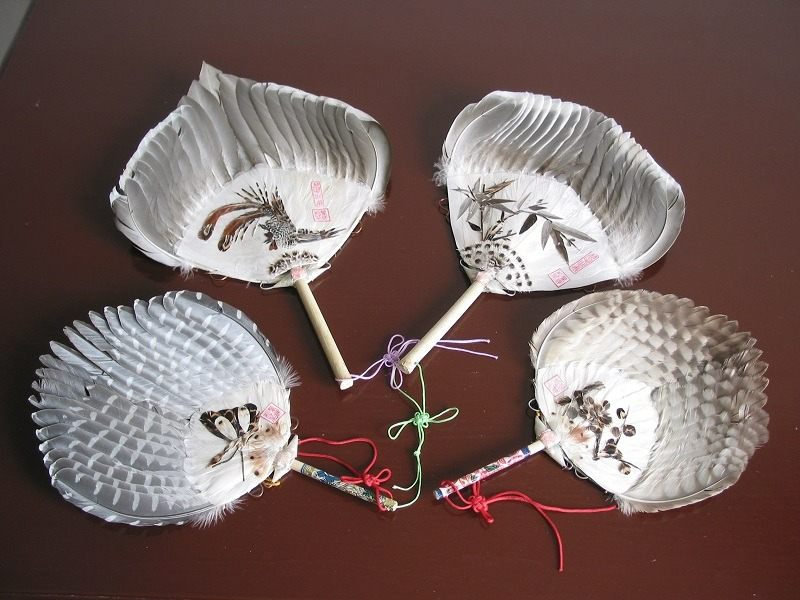
Gaochun feather fans are the most representative traditional handicraft of Gaochun, Nanjing, and a treasure of Jiangsu Province’s intangible cultural heritage. Originating in the Tang and Song dynasties and flourishing in the Ming and Qing dynasties, they boast a verifiable history of over 600 years. Legend has it that they were known as “Kongming fans” as early as the Three Kingdoms period. During the Jiajing era of the Ming Dynasty, they were officially listed as tribute items to the imperial court. By the mid-Qing Dynasty, Gaochun County had developed a feather fan industry with more than ten merchants. In the early Republic of China (1914), Gaochun feather fans were selected for the Panama-Pacific International Exposition, winning a prestigious award and gaining international renown.
I. The Splendor of the Tribute Fan: A Thousand-Year Legend of a Feather Fan
Gaochun is situated between Gucheng Lake, Danyang Lake, and Shijiu Lake, with its numerous lakeshores and abundant aquatic plants, providing a natural habitat for waterfowl such as geese, wild ducks, and cormorants, offering ideal raw materials for feather fan making. Historical records indicate that during the Jiajing era of the Ming Dynasty, Gaochun feather fans were officially listed as “tribute items.” Every year, 360 exquisitely crafted feather fans of various styles were required before the Dragon Boat Festival to be presented to the imperial palace, and the tribute was collected in Beijing on the Winter Solstice. This system continued until the Taiping Heavenly Kingdom established its capital in Tianjing (Nanjing).
In 1951, Gaochun feather fan craftsmen specially selected the most valuable carved feathers to meticulously craft four large feather fans with ivory handles in the shape of swords. These were presented to Chairman Mao, Commander-in-Chief Zhu De, and other Party and state leaders, receiving commendation from the General Office of the Central Committee of the Communist Party of China. This honor further enhanced the reputation of Gaochun feather fans after the founding of the People’s Republic of China. In 1986, inheritor Xing Xiangsheng founded the “Xingfeng Feather Fan Craft Factory,” which still stands on the old street, continuing this precious cultural heritage.
II. Over Eighty Varieties
A Thousand Styles, Each with its Own Ingenuity Gaochun feather fans currently boast over eighty varieties, with diverse shapes and exquisite craftsmanship. Fans can be categorized by shape, including fully round, semi-circular, sword-shaped, peach-shaped, pomegranate-shaped, Buddha’s hand-shaped, palm-shaped, heart-shaped, and vase-shaped. They can also be categorized by material, including carved feather fans, eagle feather fans, goose feather fans, and duck feather fans.
The combination of different feathers and shapes gives rise to a rich variety of classic styles:
Goose feather fans: Representative styles include “Han Guangming,” “Yuan Guangyue,” and “Da Yuan Dan,” with a full and rounded fan surface.
Goose feather fans: Such as “Yan Xiao Yuan” and “Yan Pingyue,” light and graceful.
Carved feather fans: Such as “Carved Sword” and “Carved Vase,” with a strong and upright shape, highly collectible.
Wing feather fans: Such as “Shao Zhong Han Yue” and “Dao Han Yue,” made using feathers from different parts of the feather, each with its own unique charm.
III. More than twenty processes
One fan, two or three days of craftsmanship. Making a qualified Gaochun feather fan requires more than twenty purely manual processes from material selection to finished product, taking two to three days to complete. Its core processes include: material preparation, washing, trimming, buttoning, handle attachment, and sewing, supplemented by decorative techniques such as attaching chrysanthemum handles, cutting down feathers, feather appliqué, and flower painting.
Each process tests the craftsman’s patience and skill: the feathers on the fan surface must be combed and trimmed one by one, and the buttoning force must be precisely controlled; the slightest carelessness will affect the flatness and durability of the fan surface. To protect rare wild birds, feather fans are now mainly made from domesticated goose feathers. Craftsmen have solved the problem of material shortage by innovating techniques such as extending the feather shafts, and further enhance the artistic value by painting on the fan surface.
IV. Elegance and Craftsmanship
The Beautiful Meaning of “Fan” and “Kindness” The characteristics of Gaochun feather fans are their gentle and refreshing breeze, lacking the stiffness of folding fans and the power of electric fans, making them especially suitable for the elderly, children, and postpartum women. Locals often say, “A feather fan provides a gentle breeze, suitable for summer but not winter.” In the folk customs of Jiangnan, the word for “fan” (扇) is a homophone for “goodness” (善), symbolizing the auspicious meaning of “being kind to others.” Gaochun also retains the custom of “sending off summer”—parents give their married daughters feather fans and other cooling items to convey affection and care.
Strolling through the old streets of Gaochun, the various shapes and sizes of feather fans remain the most vibrant cultural imprint of this water town, serving not only as practical summer cooling tools but also as elegant handicrafts with artistic value.
V. Upholding Tradition and Innovating: From Old Streets to the World, From Tradition to Modernity
Once, the practical value of feather fans diminished after the widespread adoption of air conditioning and electric fans, facing the threat of extinction. However, in recent years, thanks to the joint efforts of inheritors and the government, this ancient craft is being revitalized:
Product Innovation: Inheritor Xing Xiangsheng has dedicated over forty years to this craft, mastering not only the entire traditional technique but also innovating and developing over fifty new products. He has added decorative techniques such as feather appliqué and fan painting, and launched segmented functional models for different groups, such as a soft and breathable feather fan specifically for pregnant women.
Online Breakthrough: Inheritor Qian Xiaolan opened a Taobao store early on and has cultivated the online market for over ten years. Her store has become a double-crown store, with peak daily sales exceeding 20,000 yuan. Her products are exported to overseas markets such as the United States and Russia.
Cultural and Creative Derivatives Product Launch: Miniature feather fans, feather fan-themed cultural and creative pendants, and other products have been launched, serving as accessories for Hanfu (traditional Han clothing) and iconic intangible cultural heritage souvenirs representing the culture of Gaochun’s water towns.
Living Heritage: Activities such as bringing intangible cultural heritage into schools, communities, and old street workshops continue, allowing more people to experience the exquisite craftsmanship of feather fan making.
From ancient fans of the Three Kingdoms period to tribute items of the Ming and Qing dynasties, from the glory of the Panama-Pacific International Exposition to a best-selling product in the contemporary e-commerce era, Gaochun feather fans, refined over a thousand years, have transcended their physical form, becoming a cultural symbol embodying the cultural heritage of the water towns and the spirit of craftsmanship, continuing to write a new chapter in the inheritance of intangible cultural heritage.