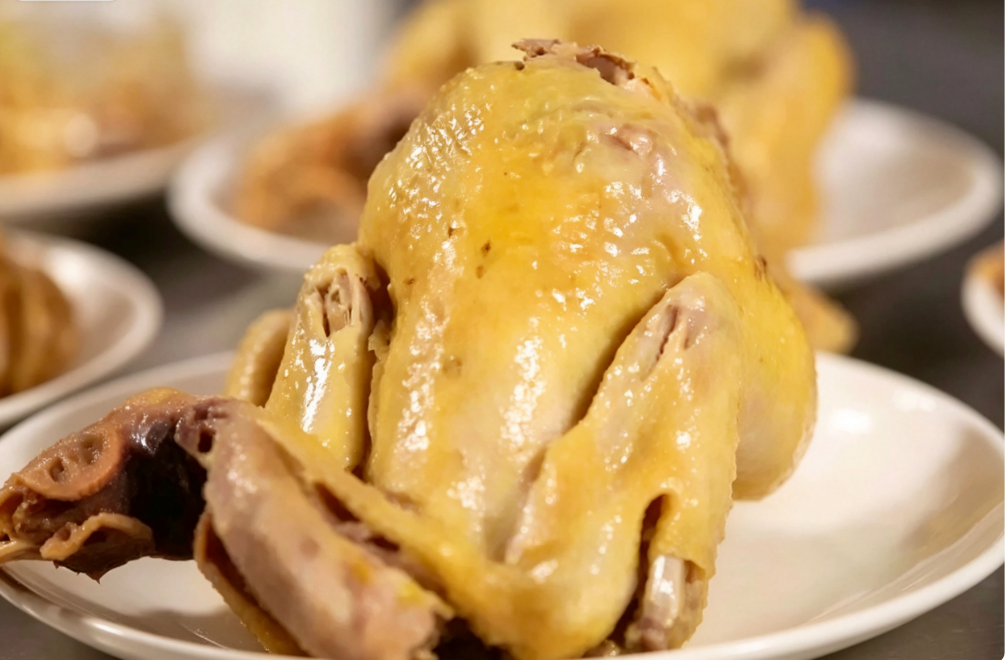
In Honglan Subdistrict, Lishui District, Nanjing, there is a dish that draws countless food lovers from dozens of kilometers away—Honglan Hand-Torn Chicken. This is more than just a rustic delicacy; it is a masterpiece of Nanjing’s Intangible Cultural Heritage and the most iconic culinary symbol of Lishui.
I. Intangible Cultural Heritage: Three Generations of Dedicated Artisans
The art of Honglan Hand-Torn Chicken has a long and rich history. During the Ming Dynasty, Honglan was already an important trading hub in Lishui. This dish was widely popular among farming families in Honglan, Putang, Kongzhen, and Shiqiu. During festivals and celebrations, local households would steam and serve their own free-range chickens at the table. In 2020, Honglan Hand-Torn Chicken was selected for Jiangsu Province’s “Top 100 Local Landmark Dishes” list. In 2023, its preparation techniques were officially inscribed in the Nanjing Municipal Intangible Cultural Heritage Representative Project List.
The inheritor, Rui Yongmei, comes from a family of three generations dedicated to making hand-torn chicken. Her grandmother, Rui Aiying, made a living by raising chickens and would first steam and then boil her own free-range chickens. Her mother inherited this craft. In 1991, Rui Yongmei founded Rui’s Hand-Torn Chicken Restaurant, continuously refining the recipe through years of practice. Using the simplest accompaniments and the three-step process of steaming, boiling, and simmering, she maximizes the preservation of the chicken’s natural flavor and aroma. Today, Rui Yongmei is not only an inheritor of intangible cultural heritage but has also been honored as one of Nanjing’s 365 Good Samaritans and a Jiangsu Provincial Love Ambassador. She has donated over 7 million yuan to charitable causes and has become “Mother Rui” to 40 disadvantaged children and “Daughter” to 108 elderly residents living alone.
II. The Art of Selection: Good Mountains and Waters Raise Good Chickens
The deliciousness of Honglan Hand-Torn Chicken begins with the strict selection of ingredients. The chickens must be free-range female mountain-roaming chickens, raised without hormone-laden feed, with their weight strictly controlled at around 2.8 to 3.3 jin (approximately 1.4 to 1.65 kg). The farms must be located in a natural environment with mountains and water, where sunlight, temperature, and humidity all align with the chickens’ natural growth conditions. Some recipes prefer free-range chickens raised for over two years, whose meat is firmer and flavor more robust.
III. Three Secrets of Preparation: The Art of Steaming, Boiling, and Simmering
The preparation of Honglan Hand-Torn Chicken may appear simple, but it conceals considerable skill. The whole chicken is first steamed, then boiled, and finally simmered over low heat—each of the three steps takes about fifteen minutes, with the control of heat and timing relying entirely on experience.
-
Steaming — Steaming the chicken in a covered pot locks in its natural juices and aroma.
-
Boiling — The chicken is placed in cold water with spices and herbs such as cinnamon, licorice, and sand ginger, allowing the herbal fragrance to slowly permeate the meat.
-
Simmering — The heat is turned off, and the chicken is left to rest, allowing the residual warmth to further tenderize the meat while the juices are fully reabsorbed.
Throughout the process, only the simplest accompaniments are used—they do not overpower the chicken’s natural flavor but rather enhance and complement it. The finished hand-torn chicken is golden in color, with springy skin, tender and juicy meat, and an irresistible aroma.
IV. The Art of Eating: Hand-Torn and Dipped in Sauce—The Authentic Way
The most authentic way to enjoy Honglan Hand-Torn Chicken is to tear it by hand. No knives or choppers—just use your hands to pull the meat apart. This preserves the chicken’s natural texture and juices while adding a rustic, communal spirit to the dining experience. The torn pieces are then dipped into the restaurant’s secret soy-based dipping sauce, whose savory, slightly spicy flavor fully unlocks the natural sweetness of the chicken. As one diner put it: “You have to dip it in their special sauce—that’s when the magic happens.”
V. Where to Find It
For the most authentic Honglan Hand-Torn Chicken experience, Rui’s Hand-Torn Chicken Restaurant (Honglan Hand-Torn Chicken & Braised Goose) is the place to go. Located on Jinniu North Road in Honglan Subdistrict, Lishui District, the restaurant has an average spend of about 70–90 RMB per person, with the hand-torn chicken being the must-order signature dish at every table. During peak tourist seasons, daily foot traffic can reach over a thousand customers, making it a true “must-visit hotspot.”
Honglan Hand-Torn Chicken—one dish, three generations, over a century of heritage. It carries not just the natural bounty of Lishui’s mountains and waters, but also a deep respect for and commitment to traditional craftsmanship. When you visit Lishui, if you don’t taste this hand-torn intangible cultural heritage delicacy, you can’t truly say you’ve been there.