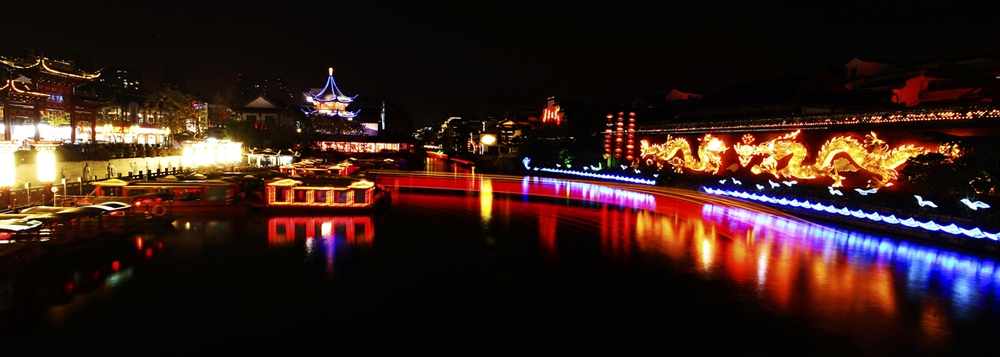
The Confucius Temple (Fuzimiao) – Qinhuai River Scenic Area is located in the central part of Qinhuai District, Nanjing. Stretching from Dongshuiguan (East Water Gate) in the east to Xishuiguan (West Water Gate) in the west, it centers around the ancient Confucius Temple complex, with the Ten-Li Inner Qinhuai River as its axis and the Ming City Wall as its connecting thread. The area links numerous nationally protected cultural relics and historical sites, covering a total area of 4.69 square kilometers. As a National AAAAA-Level Tourist Attraction, it is a comprehensive cultural destination that integrates natural scenery, landscaped gardens, temple and school buildings, streets and residences, local customs, cuisine, shopping, and festive culture. It is also China’s largest traditional ancient street market.
I. “Cultural Hub of the Realm”: From the Eastern Jin Academy to a Millennium Confucian Temple
The history of the Confucius Temple can be traced back to the Eastern Jin Dynasty (317–420 AD). According to historical records, the Eastern Jin Chancellor Wang Dao once advised that “governing a state must prioritize cultivating talent,” and established the Imperial Academy (Taixue) on the north bank of the Qinhuai River. In the first year of the Jingyou reign of the Northern Song Dynasty (1034 AD), Emperor Renzong expanded the former Eastern Jin Academy into a Confucian temple. Since Confucius had once held the title of “Grand Master” (Dafu) of the State of Lu, the temple was named “Fuzimiao” (Temple of the Grand Master). The Confucius Temple has undergone five destructions and five restorations over the centuries, with its last destruction occurring during the Japanese invasion in 1937, before being meticulously restored in the 1980s.
The temple takes the Qinhuai River in front of it as its “Pan Pond,” and the brick wall on the southern bank serves as its screen wall (zhaobi), stretching 110 meters in length—the longest screen wall in China. The temple’s main buildings—including the Dacheng Hall (Hall of Great Perfection), Mingde Hall, and Zunjing Pavilion—stand solemn and majestic, together with the Lingxing Gate and Dacheng Gate, forming a complete Confucian temple complex. As one of China’s four great Confucian temples, Fuzimiao has long been a symbol of the “Cultural Hub of the Realm” (Tianxia Wenshu).
II. “Six Dynasties Glamour”: The Prosperous Dream of the Ten-Li Qinhuai
The Qinhuai River is Nanjing’s “mother river.” Its inner section stretches five kilometers, historically known as the “Ten-Li Qinhuai,” and forms the heart of the Confucius Temple – Qinhuai River Scenic Area. During the Six Dynasties period, the area along the Qinhuai River near the Confucius Temple was already a thriving commercial center. After the Eastern Jin Dynasty, places such as Wuyi Lane, Zhujie Street, and Taoye Du (Peach Leaf Ferry) became residences of noble families, bustling with merchants and gathering places for scholars and literati. Along both banks of the Qinhuai River, singing and drinking establishments stood side by side, riverfront pavilions vied in splendor, painted pleasure boats shuttled across the water, and lights blazed into the night—earning it the reputation of “Six Dynasties Glamour” (Liuchao Jinfen).
During the Ming and Qing dynasties, the Qinhuai River area became even more densely populated, with golden pavilions, painted boats gliding across the waves, and the sound of oars and lantern light painting an unforgettable scene. The Tang Dynasty poet Du Mu’s famous lines—”Cold water veiled in mist and moon veiled in sand, I moor my boat at night by the Qinhuai, near taverns’ lights”—have been celebrated for over a millennium. Liu Yuxi’s verse, “The swallows that once nested in the Wang and Xie mansions now fly into ordinary homes,” made Wuyi Lane famous throughout the land. The Ten-Li Qinhuai has enchanted countless romantic scholars and literary masters, giving rise to Nanjing’s most romantic cultural memories.
III. Highlights of the Scenic Area: A Millennial Cultural Journey
The Confucius Temple – Qinhuai River Scenic Area is home to a wealth of historic sites, each a brilliant jewel along the river:
-
Confucius Temple (Fuzimiao) : A sacred site dedicated to Confucius, one of China’s four great Confucian temples, and the core of the scenic area.
-
Jiangnan Examination Hall (Jiangnan Gongyuan) : The largest imperial examination venue in ancient China, where candidates from Jiangsu and Anhui provinces took their exams during the Ming and Qing dynasties. It originally housed over 20,000 examination booths—three times the size of the Forbidden City in Beijing—and produced more than 800 top scholars (zhuangyuan) and jinshi graduates, including Tang Bohu and Zheng Banqiao.
-
Zhan Yuan (Zhan Garden) : Known as the “First Garden of the Southern Capital” during the Ming Dynasty. In the Qing Dynasty, it was ranked alongside Shanghai’s Yuyuan Garden, Suzhou’s Humble Administrator’s Garden and Lingering Garden, and Wuxi’s Jichang Garden as one of the “Five Great Gardens of Jiangnan.” Today, it is hailed as the “First Garden of Jinling” and houses a museum dedicated to the history of the Taiping Heavenly Kingdom.
-
Zhonghua Gate Barbican : The world’s largest and best-preserved barbican city gate.
-
Wuyi Lane and Taoye Du (Peach Leaf Ferry) : The former residences of Eastern Jin Chancellor Wang Dao and General Xie An; a gathering place for Six Dynasties nobility.
-
Li Xiangjun’s Former Residence (Meixiang Lou) : The setting of the legendary drama The Peach Blossom Fan from the late Ming and early Qing dynasties.
-
Bailuzhou Park : The former private garden of Xu Da, a founding general of the Ming Dynasty.
Along the riverbanks, ancient streets and lanes crisscross, their green brick and black-tiled buildings exuding the charm of Ming and Qing architecture.
IV. Night Cruise on the Qinhuai: The Gentle Glow of Lantern Light and Oar Song
The most celebrated experience at the Confucius Temple is undoubtedly the night cruise on the Qinhuai River. Under the night sky, the riverbanks burst into brilliant lights, with lanterns of red and gold glowing in succession, their reflection shimmering on the water like a dreamscape. Boarding a painted pleasure boat, you glide along the thousand-year-old river, passing by the Confucius Temple, Wuyi Lane, ancient city walls, and other iconic sites, while an audio guide shares the stories of Nanjing’s millennia-long history. The “flavor of the Qinhuai that night,” as described by the renowned essayist Zhu Ziqing, becomes vivid and tangible in this moment.
In October 2021, the Confucius Temple – Qinhuai River Scenic Area was selected as one of the first National Nighttime Cultural and Tourism Consumption Agglomeration Zones, further affirming the unique allure of “mooring by the Qinhuai at night.”
V. Qinhuai Cuisine: Jinling’s Taste Memories on the Tongue
The culinary culture of the Confucius Temple area has a long and distinguished history, dating back to the Six Dynasties and flourishing in the Ming and Qing dynasties. Represented by the “Eight Delicacies of Qinhuai,” the area’s famous snacks offer a balanced combination of dry and soupy dishes, and vegetarian and meat options. Duck blood and vermicelli soup warms the stomach with its refreshing flavor; Jinling soup dumplings are bursting with savory broth; osmanthus sweet taro balls are sticky, sweet, and dense; and plum blossom cakes are crispy on the outside and soft within. Along the streets, time-honored tea houses and restaurants—such as Qifang Pavilion and Jiang Youji—stand side by side, offering visitors the chance to savor both delicious food and the charming Qinhuai atmosphere.
VI. Visitor Information
-
Address: Fuzimiao Pedestrian Street, Qinhuai District, Nanjing (accessible via Metro Line 1 to Sanshanjie Station or Metro Line 3 to Fuzimiao Station)
-
Opening Hours: Open all day (some attractions and boat tours have fixed operating hours)
-
Admission: The scenic area is free; some individual attractions (such as Jiangnan Examination Hall and Zhan Garden) charge separate admission fees
-
Recommended Visit Duration: Half a day to a full day (an afternoon-to-evening visit is recommended to experience both daytime and nighttime scenery)
-
Best Seasons: Spring and autumn are optimal—spring brings peach blossoms and green willows along the riverbanks, while autumn nights offer bright moons and the fragrance of osmanthus
-
Must-Do Experience: Night cruise on a Qinhuai painted boat (departing from Pan Pond Pier at No. 152 Gongyuan Street, with audio guides in Chinese and English)
The Confucius Temple – Qinhuai River Scenic Area is a microcosm of Nanjing’s 2,000-year history. Culture and commerce intertwine here; ancient charm and everyday vitality merge in harmony. The Ten-Li Qinhuai, with its flickering lantern light and oar-song melodies, stands as a living museum of history, quietly awaiting every visitor to read—and savor—the deepest, most tender cultural essence of Nanjing.