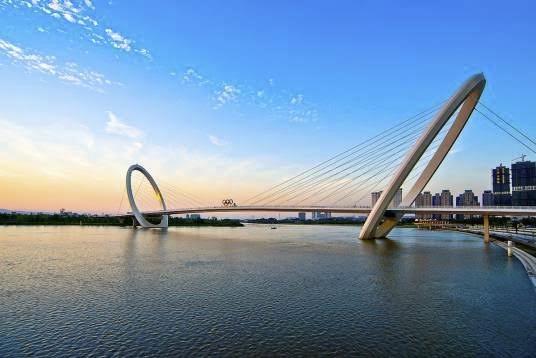
Spanning the Yangtze River’s Jiajiang channel between Hexi New Town and Jiangxin Island in Nanjing lies a bridge of striking dynamism and elegance—the Nanjing Eye Pedestrian Bridge. As the first sightseeing pedestrian bridge across the Yangtze River, it takes its name from its two enormous elliptical bridge towers, which resemble a pair of eyes gazing upon the river. Since its completion, it has become one of Nanjing’s most iconic modern cultural symbols.
I. Born from the Youth Olympics: A Bridge and a City’s Youthful Memory
The Nanjing Eye Pedestrian Bridge was built as an auxiliary facility for the 2014 Nanjing Youth Olympic Games. Construction began in January 2013, and the bridge officially opened to the public on August 16, 2014. It connects the Youth Olympic Forest Park on Jiangxin Island in the north to the Nanjing International Youth Cultural Center in the south, with a total length of 827.5 meters, a main bridge span of 531.5 meters, a main span of 240 meters, and a deck width that gradually widens from 10 to 22 meters.
In March 2014, a global naming campaign attracted nearly 50,000 submissions. Ultimately, “Nanjing Eye,” proposed by a post-1980s Nanjing native, won with 28.85 percent of the votes—the two Q-shaped oval towers, resembling a pair of eyes, were both vivid and endearing, and the name has stuck ever since.
II. Architectural Beauty: Strings Like a Harp, A Sash Like White Jade
The design of the Nanjing Eye Pedestrian Bridge is itself a poem in motion. Ancient Jiangnan bridges are mostly stone arch bridges, yet the Nanjing Eye ingeniously responds to this tradition with a modern touch—its deck arches slightly upward in the middle, echoing the classical poetic imagery of “small bridges, flowing water, and households.”
The two elliptical, inclined towers face each other yet appear slightly separated, suggesting the idea of “completeness.” The winged, diagonally stretched steel cables seem to soar upward like the strings of a giant harp, with pedestrians passing through like dancing musical notes leaping across the strings. From a distance, the two white rings resemble a white jade sash tied across the Jiajiang, connecting Hexi New Town with Jiangxin Island and expanding the city’s framework. Up close, the two towers appear like two friends giving each other a thumbs-up—one marveling at the vibrant growth of the new town, the other cheering for the boundless energy of the Youth Olympic athletes.
To achieve this light and graceful effect, the designers cleverly concealed the massive bridge pier foundations underwater—the twin rings rest upon 650 square meters of underwater foundations connected to nearly a hundred steel pipe piles, each 1.7 meters in diameter and driven over 50 meters deep into the riverbed. To prevent the “twin rings” from rusting where they meet the water, three-quarters of the rings are steel, while the sections in contact with the river are made of concrete, seamlessly joined through stud connectors and prestressed tendons—invisible to the naked eye.
III. Walking on the Bridge: Strolling Above the River, Traveling Within a Painting
The Nanjing Eye Pedestrian Bridge is open only to pedestrians and tourist electric vehicles—a pure slow-traffic bridge. Strolling across, you have the rolling Jiajiang current beneath your feet, silver cables slanting skyward beside you, and the Hexi New Town skyline merging with the vast river horizon in the distance. The figures of morning joggers, the lenses of photography enthusiasts, and the smiling faces of families interweave on the bridge deck, painting a vibrant picture of urban life.
A particularly thoughtful feature is the bridge’s variable width design—at the best viewing and photo spots, the deck naturally widens, allowing visitors to stop and take photos without blocking the flow of foot traffic. The bridge railings feature double handrails—the upper for adults and the lower for children and wheelchair users. Lighting fixtures are embedded into the handrails, seamlessly integrated with the bridge structure.
IV. A New Riverside Landmark: From Internet Sensation to National 4A-Level Scenic Area
The Nanjing Eye’s accolades extend beyond its appearance. In 2015, it won the International Bridge Conference (IBC) Arthur G. Hayden Medal—the first time a Chinese bridge received this honor, marking a breakthrough in China’s bridge construction field. At the end of 2024, the Nanjing Eye Tourist Area was successfully elevated to a National 4A-Level Tourist Attraction.
V. Visitor Information
-
Location: Jianye District, Nanjing, connecting Hexi New Town with Jiangxin Island
-
Opening Hours: Open 24 hours
-
Admission: Free
-
Transport: Metro Line 10 to Jiangxin Island Station, or take a bus to the “Nanjing Eye” stop
-
Best Time to Visit: Evening to night—when the lights come on, hundreds of lights along the cables illuminate in sequence, reflecting on the river surface in a dreamlike display
-
Nearby Attractions: The northern end connects to the Youth Olympic Forest Park; the southern end connects to the Nanjing International Youth Cultural Center and the Nanjing Olympic Museum. It can be combined with the Hexi Riverside Scenic Belt for a full tour.
The Nanjing Eye is both a transportation link and a viewing corridor; both a vessel of Youth Olympic memory and an everyday backdrop to Nanjing’s new urban life. Standing atop this pair of “eyes,” watching the great river flow eastward, the tides rise and fall—you’ll find that ancient Jinling, with a pair of clear, bright eyes, is now gazing toward the future.