At six o’clock in the morning, the sycamore trees on Yihe Road were still shrouded in a thin mist. Light filtered through the foliage, scattering into patches of light on the yellow-walled, old Western-style houses. An elderly man in a white shirt walked past, pushing his bicycle; its basket held fried dough sticks and soya milk, the clinking of the chain echoing far down the deserted street. The Yihe Road mansion district is home to over a hundred historic residences from the Republic of China era; each stands silently within its courtyard, its iron gates firmly locked, whilst ivy spills over the walls, obscuring more than half their surface. On a morning devoid of tourists, this place truly reveals the weight of its reputation as ‘half the history of the Republic of China’—quiet and profound, where even the falling leaves seem to drift down with unhurried grace.
Heading south along Ninghai Road, the cafés in Taogu New Village have just opened for the day. The owner has set out a small blackboard at the entrance, writing today’s special drinks in chalk. Students from Nanjing University ride their electric scooters through the streets, their rucksack straps swinging loosely. This narrow lane, shaded by towering plane trees, connects the two universities—Nanjing University and the Nanjing University of the Arts—and bridges the two sides of Nanjing: the youngest and the oldest.
At eight o’clock in the morning, a queue forms outside the egg-stuffed pancake stall on the back street of the Nanjing University of the Arts. The proprietress cracks eggs with one hand, the pancake sizzling on the griddle. A university student at the front turns to his companion and says, ‘I’ve been graduated for three years now, but I eat this every time I come back.’ The pancake is crispy, the sauce savoury and aromatic; filled with lettuce and pork tenderloin, it’s so hot that he has to switch it from his left hand to his right, yet refuses to put it down. Not far away, on the Nanjing Arts Institute campus, posters for the graduation exhibition have just gone up, and students are bustling about carrying models of their work, their eyes reflecting the exhaustion of the final rush and uncertainty about the future.
At midday, walking into Shiziqiao on Hunan Road, the flagship branch of Nanjing Dapaidang is tucked away deep within the pedestrian street. The candied baby taro was still steaming when it arrived; the lotus root starch sauce was crystal-clear, and the tiny taro tubers had been stewed until they melted in the mouth. An elderly man at the neighbouring table had been sitting alone all afternoon, with nothing before him but a steamer basket of dumplings and a pot of Yuhua tea, leisurely leafing through a newspaper and occasionally glancing out of the window at the passers-by. The slow pace of Nanjing is thus encapsulated in the time spent over a single lunch.
In the afternoon, I climbed Yuejiang Tower. Lion Mountain is not particularly high, but as the tower stands on its summit, the view is completely unobstructed. The Yangtze River flows beneath my feet, and the Nanjing Yangtze River Bridge spans the river, with traffic on the bridge as thin as a line of ants. Six hundred years ago, when Zhu Yuanzhang wrote his ‘Record of Yuejiang Tower’, the tower had not yet been built—it was not until 2001 that the structure was finally erected. The inscription came first, followed by the tower—a unique feature amongst the famous towers of Jiangnan. The wind blows in from the river, carrying the scent of water and the sound of ship’s horns, reminding one of those who stood here in the Ming Dynasty gazing out over the river and the sea.
As dusk fell, the chimes of Jinghai Temple drifted in from afar. This temple, commissioned by the Ming Emperor Chengzu to commemorate Zheng He’s voyages to the Western Seas, now houses a museum displaying historical materials relating to the Treaty of Nanjing. The leaves of the ancient ginkgo tree within the temple grounds are turning yellow, falling one by one onto the bluestone paving. A little girl asks her mother, ‘Why do we have to remember unhappy things here?’ Her mother crouches down and whispers, ‘Because if we remember them, they won’t happen again.’ ” Nearby, the red walls of Tianfei Palace stood out strikingly against the setting sun, whilst the statue of Mazu stood quietly within the hall, blessing those setting out on long journeys just as she had done six hundred years ago when Zheng He’s fleet set sail.
As night fell, I walked into Sanpailou, which felt like a completely different world. The grill at Bainan Barbecue was blazing, and the scent of cumin and chilli mingled with the night breeze, wafting down the entire street. A group of middle-aged men sat huddled around a low table; the crushed garlic on the grilled fish was still sizzling, whilst beer bottles clinked together with a crisp sound. At the neighbouring table, a young couple shared a pot of congee, their spoons gently tapping against the rims of their bowls. The hustle and bustle of everyday life rises, permeates and takes root here, forming the most unpretentious backdrop of Gulou District.
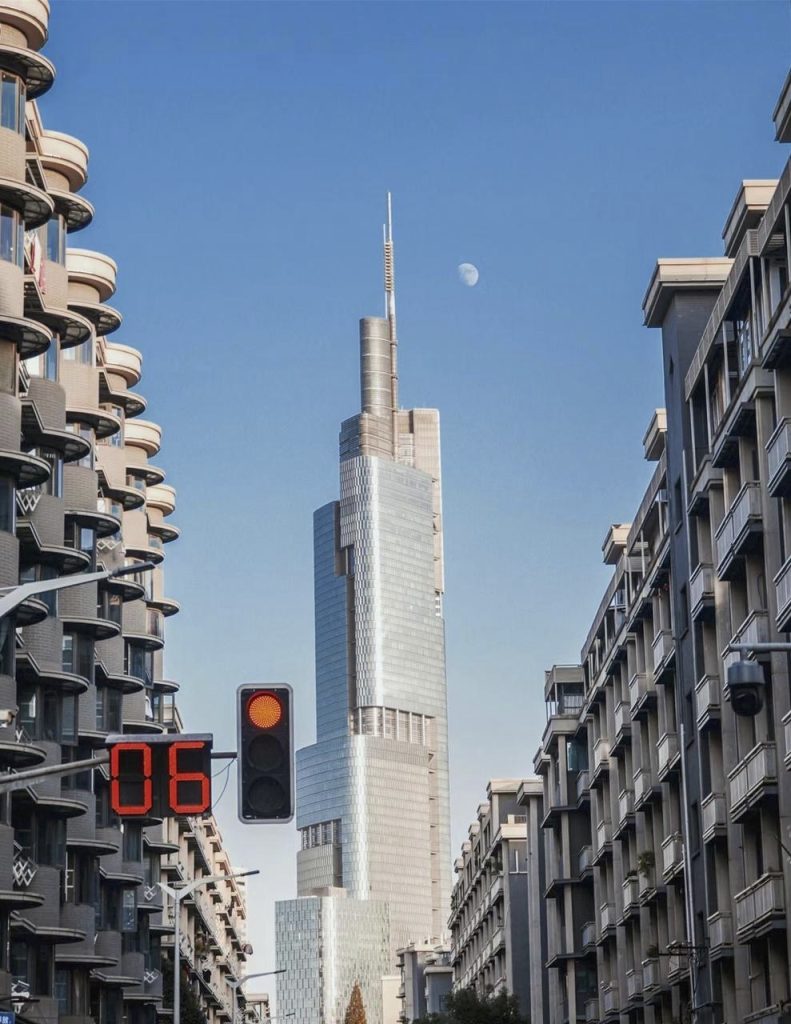
Leaving Sanpailou late at night, I looked back over my shoulder at the street corner. The lights of Zifeng Tower were still on, like a silver needle piercing the night sky. The plane trees on Yihe Road were still swaying gently in the breeze; Yuejiang Tower on the summit of Lion Hill was now merely a silhouette; and who knows how many more ginkgo leaves had fallen from Jinghai Temple.
Gulou District lacks the clamour of Confucius Temple and the sight of oars and lanterns on the Qinhuai River. Its stories lie hidden in the bicycle bells ringing at dawn on Yihe Road, in the lights of Nanjing Arts Institute students setting up their graduation exhibition at three in the morning, and in the crackling of charcoal fires at Sanpailou. A food delivery rider carrying a clay pot passes by; the sound of a new order notification rings out from his mobile, whilst his tyres crunch softly over fallen plane tree leaves. The night in Gulou never rests, just like the heart of this city, beating steadily, beat by beat, deep within the passage of time.