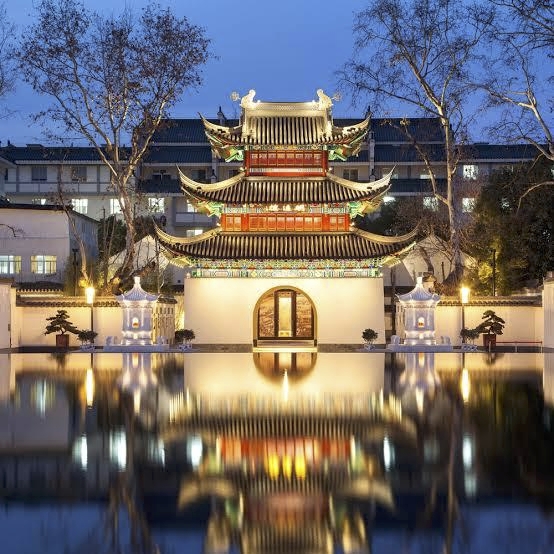
At seven o’clock in the morning, beneath the Lingxing Gate at Confucius Temple, the dawn light was creeping inch by inch up the backs of the stone lions. The Panchi Pond in front of the Dacheng Hall was as still as an ancient mirror, reflecting the 110-metre-long red screen wall on the opposite bank—the longest of its kind in the country, which has silently gazed upon the waters of the Qinhuai River for six hundred years. An elderly cleaner walked past carrying a bucket; the sound of the mop scraping across the flagstones rang out with striking clarity across the empty square. With no tourists in sight, the Confucius Temple finally revealed its true nature: the site of an ancient academy dating back to the Northern Song Dynasty, once filled with the sound of students’ voices, now so quiet that one could hear sparrows hopping along the eaves. A truly fine place can only be appreciated before the tourists stir.
A five-minute walk from the Confucius Temple, the ruins of the examination cells at the Jiangnan Imperial Examination Hall nestle in a corner of the bustling city centre. Those cramped, blue-brick cubicles—one metre wide and two metres deep—were where a single candidate would spend nine days and six nights. On display in a glass case is a cheat sheet used by a Qing Dynasty candidate: a piece of paper measuring just one cun square, crammed with over 40,000 characters, written in such painstakingly neat, minuscule regular script that it is almost heartbreaking. Not a single visitor in our group spoke; the air was filled only with the sound of footsteps and the occasional sigh. Meanwhile, in the underground exhibition hall of the Nanjing Museum of the Imperial Examination System, the ramps on either side were piled high with examination papers and essays from candidates throughout the ages; those yellowed pages were filled with the aspirations of countless people seeking to change their destinies.
At midday, I slipped into Lane 378; the true flavour of the Qinhuai lies not within the tourist areas. A queue of over a dozen people had already formed at the smoked fish stall at the entrance to the lane; golden-brown chunks of fish bubbled in the oil, their aroma wafting all the way to the far end of the lane. Next door, at the shop selling lotus root in rock sugar syrup, the proprietress was scooping out segments of maroon-coloured lotus root from a large pot; the holes were stuffed with glutinous rice, and when cut open, one could see amber-coloured, stringy strands. A local lady bought a whole segment, and as the proprietress weighed it, she remarked, ‘This lotus root needs to be stewed for three hours; if it isn’t cooked just right, it won’t taste good.’ ’ Sitting on a low stool in the alley, I ate a bowl of red-bean glutinous rice balls. The lotus-root-starch thickening was crystal-clear; the little rice balls were soft and chewy, and the red beans had been simmered until they’d dissolved, crumbling into a sandy texture at the slightest touch of the tongue. The soul of a city, it turns out, is hidden in the most unassuming of alleys.
In the afternoon, I wandered into Lao Mendong, where the bluestone pavements had been polished to a shine, flanked on either side by reconstructed dwellings from the late Qing and early Republican eras. In a narrow alley, a felt flower artisan was crafting a peony. Silk thread was twisted, wound and shaped between her fingertips; it took half an hour just to complete a single petal. ‘It takes two days to make a single peony,’ she said, ‘ ‘This craft has been passed down from the imperial court; in *Dream of the Red Chamber*, it is called “piled gauze flowers”.’” At the other end of the alley, a master craftsman specialising in Jinling folding fans was carving characters onto the bamboo ribs with a blade; bamboo shavings flew wherever the blade tip passed, yet every stroke was executed with meticulous precision. These artisans are all preserving their traditional crafts; every movement carries the weight of centuries, and as tourists come and go, they do not even look up.
As dusk falls, the outline of the Zhonghua Gate barbican gradually comes into view against the skyline. This is the largest surviving barbican in China, containing three arched gates and four walls, with the names of the brickmakers and supervising officials engraved on every single brick. At this very pass, once a scene of clamour and conflict, the ‘Heart Imprint: Zhonghua Gate’ light and sound show is now staged every evening. As the lights project historical scenes onto the city walls, the arrow towers and battlements of yesteryear come to life: some ride horses at full gallop, whilst others light beacon fires. An elderly man stood in a corner watching the entire performance; even after it had ended, he continued to gaze up at the city walls. He took no photographs, made no comments—he simply stood there quietly for a long time.
A night-time cruise on the Qinhuai River marked the perfect conclusion to the day. The painted barge set off from Panchi Wharf, the sound of oars breaking the reflections of the lights on the water’s surface. The homes along the Qinhuai River, as well as the riverside pavilions and waterfront pavilions on both banks, were hung with lanterns; red and yellow lights rippled across the water, resembling countless shards of gold. The Pingtan performer on board began to sing *Scenes of the Qinhuai*, his soft Wu dialect flowing as smoothly as the waters of the Qinhuai River. As we approached Wende Bridge, the tour guide pointed to the water and said, ‘This is where Li Bai tried to scoop up the moon.’ Though the legend may not be true, the moment the boat passed beneath the bridge, everyone fell silent. The full moon hung precisely in the centre of the arch, whilst the lights on both banks bathed half the river in warm hues, leaving the other half shrouded in the inky darkness of night. The ancient saying, ‘The sound of oars and the glow of lanterns stretch for ten li’, was, it turned out, no exaggeration.
After disembarking and looking back at the Qinhuai River, the painted boats were still gliding slowly across the water, their lantern lights trailing long reflections in the current. The lights of Confucius Temple burn all night long; people still wander through the alleys of Laomendong; and the bastion of Zhonghua Gate stands silent as a mountain in the night. And those smoked fish in the myriad alleys, the peonies crafted by the fingertips of the velvet flower artisans, and the landscapes carved by the bamboo engravers—all are scattered throughout the city’s folds, flowing day and night like the waters of the Qinhuai River: silently, yet never ceasing. People come and go, but the Qinhuai remains the same; the millennia enshrined in the sounds of oars and the glow of lanterns have never needed to be carried away by anyone.