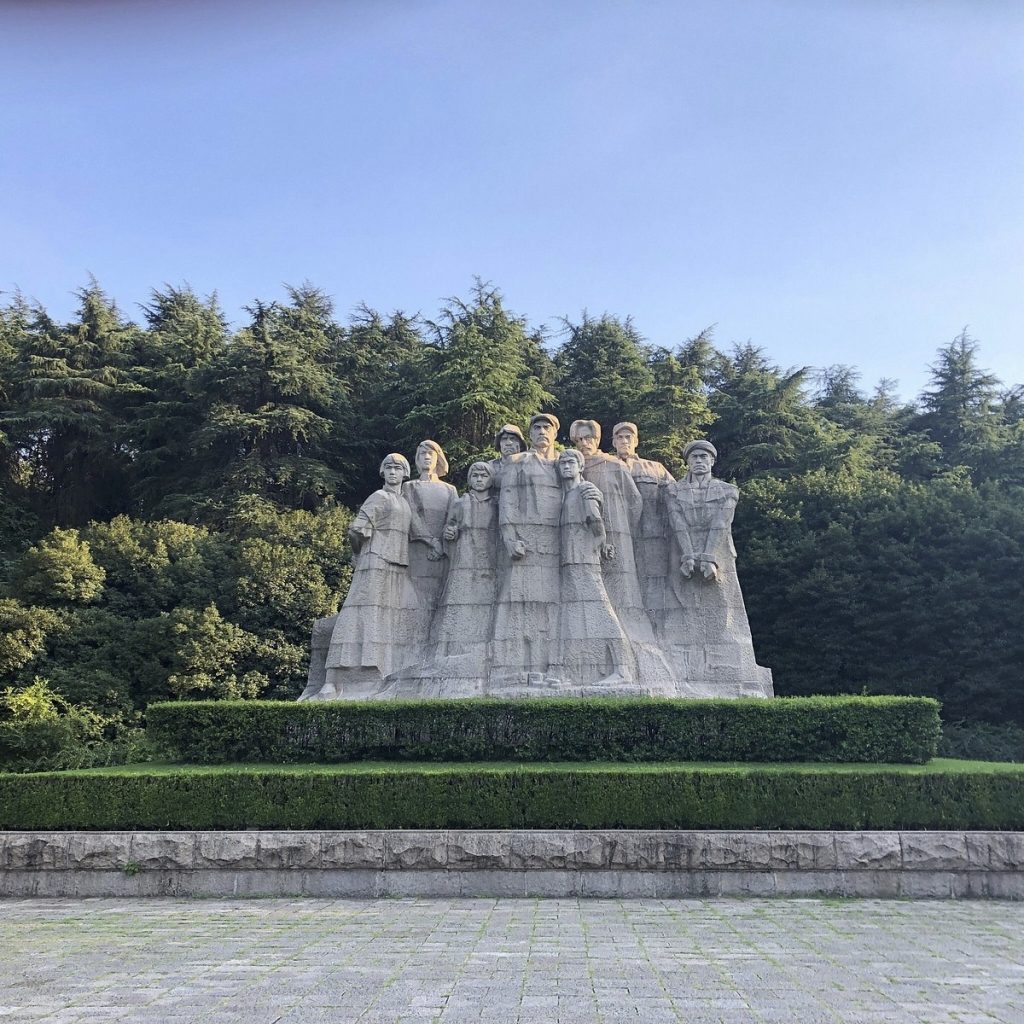
At seven o’clock in the morning, the steps of the Yuhuatai Martyrs’ Cemetery still carried the chill of the night. The eternal flame burned quietly before the memorial; though the morning breeze kept the flame low, it never went out. An elderly man in a worn military uniform stood before the flame, his back held straight as an old pine tree. He said nothing, but simply stood there in silence for a long time. Not far away, a cleaner was sweeping up fallen leaves; the sound of the broom sweeping across the ground was as regular as the tides. At the quietest hour of the memorial park, only the faint crackle of the flame and the birdsong echoed in harmony. This flame has burned continuously since it was lit on the National Memorial Day in 2014; come rain or shine, it has always shone here.
As the memorial hall opened its doors, light streamed diagonally through the high windows, falling upon Yun Daiying’s manuscripts written in prison. The letter paper in the glass display case had yellowed, and the ink had faded to a pale brown, yet the handwriting remained clear. The line, ‘Wandering the rivers and lakes, I recall old friends; the lives and deaths of old friends are matters of a thousand autumns’, was written in the corner of the page, as if jotted down casually, yet it has become the phrase that strikes the heart most deeply. In the display case next door lies a pair of cloth shoes, meticulously stitched by his mother for her son in prison; yet by the time they arrived, he was no longer there. The shoes sit there quietly, yet carry more weight than any explanatory text.
Upon exiting the southern gate of the memorial park, the stalls in the Yuhua Stone Cultural Area had already been set up. The shopkeeper brought out a basin of water and submerged a few stones. The moment those parched pebbles touched the water, they suddenly came to life—agate-red stripes swirled amidst the ripples, whilst the translucent parts resembled frozen morning dew. ‘To see a genuine Yuhua stone, you must look at it in water,’ she said. ‘The patterns have layers.’ She scooped one up and handed it to me; the stone felt heavy in my palm, its coolness spreading along the lines of my hand. This stone, originating from the ancient gravel layers of the Yangtze River six million years ago, had been polished into its present form by flowing water and the passage of time. The stone remained silent, yet it held all the secrets of this land.
At midday, we popped into the Nengrenli Market, where seven or eight people were queuing at the smoked fish stall. The proprietress lifted golden-brown chunks of fish from the oil, gave them a quick shake in the slotted spoon to drain off the excess oil, and plunged them, whilst still hot, into the dark brown marinade beside her. With a ‘sizzle’, the scalding fish contracted upon contact with the cold liquid, instantly soaking up the rich flavour. I bought a piece and stood by the roadside to take a bite. The crust cracked as it was so crisp, whilst the fish flesh inside remained tender and smooth, with a perfectly balanced sweet and salty flavour and a lingering hint of five-spice. Next to me, a woman selling vegetable pancakes was stuffing chives and eggs into the dough; the oil sizzled on the griddle. The food here is just like the people: no fuss over presentation, no pursuit of refinement, yet every mouthful is hearty, piping hot and authentic.
In the afternoon, I walked into the Chenguang 1865 Creative Industry Park, where the red-brick walls of the old factory buildings still bore the brick-carved inscription ‘1967’. Inside the old workshop of the Jinling Machinery Manufacturing Bureau, the massive steel gears—long since rusted—stand frozen in time, serving as a backdrop to the afternoon café. Beyond the floor-to-ceiling windows, a tributary of the Qinhuai River flows gently by; occasionally, a pleasure boat passes over the water, its passengers waving in our direction, whilst the reflection in my coffee cup shatters and coalesces anew. In the studio next door, a designer is sanding a piece of cowhide, the hammer striking the leather with a dull thud. From machine guns to leather goods, this factory complex has taken on countless forms over the past 160 years, yet it has always been creating something—it is simply that the nature of what it creates has changed.
Arriving at Huashen Lake at dusk, the sun was setting between the blocks of flats to the west of the lake. The water’s surface was bathed in an orange-red glow, whilst a few waterbirds skimmed the surface, their wings almost brushing their own reflections. Sitting on a bench by the lake, I watched joggers pass by lap after lap and an elderly man walking his dog stroll leisurely from one end of the lake to the other. The cherry blossoms lining both sides of Huasheng Avenue had long since fallen, but the trees, now full of green leaves, took on a gentle golden-green hue in the setting sun. It is not as bustling as Xuanwu Lake, but it has a quiet, everyday feel to it that makes one feel this is how life ought to be.