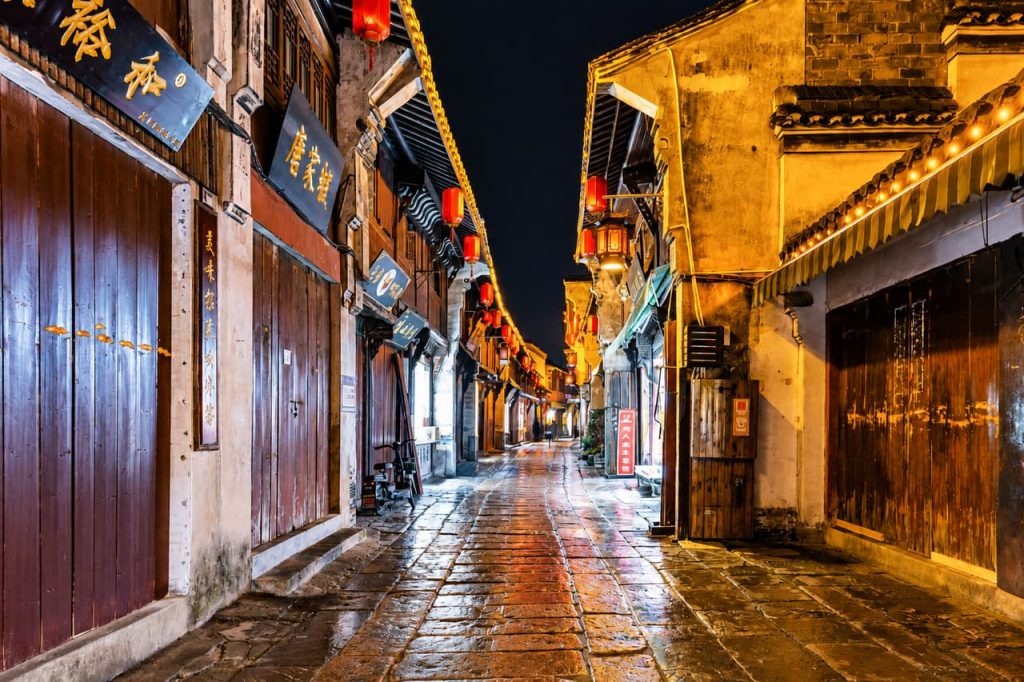
In Gaochun District, at the southernmost tip of Nanjing, lies an ancient street that has endured nine centuries of wind and rain yet remains vibrantly alive today. First established in the Song Dynasty and officially taking shape as a market town during the Ming Dynasty, it stretches 1,135 meters in total length, with approximately 800 meters still open to visitors today. It is the best-preserved Ming and Qing Dynasty ancient street in Jiangsu Province and has been hailed as the “Finest Ancient Street in Jinling.” In 2012, it was selected as one of China’s “Famous Historical and Cultural Streets” and one of the “New Forty-Eight Scenic Sights of Jinling,” and in 2013, it was elevated to a National 4A-Level Tourist Attraction.
The renowned sociologist Fei Xiaotong once visited the old street and inscribed two plaques—”Gaochun Old Street” and “The Finest Ancient Street in Jinling”—which still hang above the memorial archway at the street’s entrance, bearing witness to this ancient street’s extraordinary status.
I. A Commercial Hub Born of Trade, an Architectural Corridor Blending Hui and Su Styles
Since ancient times, Gaochun Old Street has served as a land-and-water trading hub connecting Jiangsu and Anhui provinces. It was built along the Guanxi River—a waterway that connects Gucheng Lake and Xuxi River to the east, and Shijiu Lake and Danyang Lake to the west. This river system was a vital link between the Taihu Lake and Yangtze River watersheds, and a distribution center for bulk commodity trading between southern Jiangsu and southern Anhui. The Qing Dynasty poet Chen Qi captured the bustling scene in his poem Song of Selling Yarn: “The rooster’s crow urges the selling of yarn, waking every neighbor near and far. In steady streams they come to town, a thousand waiting for the gates to open.“
The old street flourished through commerce. Its merchants primarily came from Huizhou in southern Anhui and the Taihu Lake basin, resulting in a unique architectural style that blends the white walls, black tiles, and horse-head walls of Huizhou architecture with the refined lightness of the Xiangshan School from southern Jiangsu. Architectural experts have praised it as a “transitional style between southern Anhui Huizhou architecture and southern Jiangsu Xiangshan architecture. “
The street is approximately 3.5 meters wide, paved with bluish-grey flagstones laid lengthwise on both sides, with crimson “rouge stones” arranged horizontally down the center. The harmonious tones remain as solid as jade, despite centuries of foot and cart traffic. The shops lining the street are mostly two-story brick-and-wood structures, complete with overhanging eaves, brackets, parapet walls, and lattice windows, with exquisite carvings adorning the diagonal braces, tie beams, lintels, and window panels.
One of the most eye-catching features of the old street is the calligraphic shop signs—each composed of four characters that reflect the owner’s trade. A grocery store reads “The Legacy of Duanmu” (referring to a disciple of Confucius known for integrity in commerce), a traditional pharmacy proclaims “Miraculous Remedies for the World,” a teahouse declares “Lu Yu and Lu Tong Stop Here” (honoring two tea sages), and a feather-fan shop boldly displays “Tribute Fans Offered.” Lined up in a row, these signs are like a calligraphy exhibition unfurled along the street, steeped in antiquity and redolent with the fragrance of ink.
II. The Temple of Guan Yu: The Only Red-Walled Ancient Temple South of the Yangtze
At the middle section of the old street, a temple with red walls and yellow tiles stands out vividly—this is the Temple of Guan Yu, the only existing main hall in the Jiangnan region dedicated to the revered Three Kingdoms general Guan Yu. First built in the fourth year of the Hongzhi reign of the Ming Dynasty (1491), its red walls and black tiles exude the solemn dignity of centuries past.
Nestled amid the bustling marketplace, the temple offers its own peaceful haven once you push open its wooden doors. Inside, ancient ginkgo trees reach skyward, their branches adorned with red prayer ribbons that flutter in the autumn breeze, carpeting the ground with golden leaves. Amid the curling incense smoke, the statue of Guan Yu sits in dignified majesty, his spirit of “loyalty and righteousness” transcending centuries to inspire awe in all who enter. The Temple of Guan Yu is more than a place of worship—it is a “spiritual sanctuary” for the old street’s residents, who come here to pray, meditate, and find a quiet refuge from the clamor of everyday life.
III. The Wu Clan Ancestral Hall: A Nanmu Hall and a Red Monument
At the easternmost end of the old street, beside the Guanxi River, stands Gaochun’s most renowned ancient building—the Wu Clan Ancestral Hall. First built in the 46th year of the Qianlong reign of the Qing Dynasty (1781), it was designed to follow the terrain, with its gate facing the Guanxi River and its back resting against the old street. The layout comprises the front gate (housing a theater stage), the central hall for ancestral worship, and the rear hall for sacrificial ceremonies, separated by courtyards and flanked by side chambers.
Flanking the main gate are “eight-character” screen walls, built with layered green bricks upon stone foundations, with round drum-shaped stones placed on both sides—solemn and dignified. But what astonishes visitors most is the exquisite theater stage built into the back of the front gate—a masterful design that combines the entrance with a performance stage. The stage is situated on the second floor, divided into front and back sections by a screen, with “Exit for the General” inscribed on the left and “Entrance for the Minister” on the right. The ceiling features a three-tiered octagonal coffered dome (zaojing) , which not only adds decorative splendor but also enhances acoustics by resonating and amplifying sound during performances.
The central and rear halls are classic Huizhou-style architecture. Their greatest treasure lies in the nanmu pillars and cypress wood beams—materials of exceptional quality whose natural fragrance repels insects and spiders, keeping the beams free from cobwebs and dust for centuries, as fresh as if newly built. The wood carvings on the beams and columns are unparalleled in Jiangnan: over eighty carved panels adorn the stage, featuring motifs such as “Twin Phoenixes Playing with Peonies,” “Twin Dragons Playing with a Pearl,” operatic scenes like The Full Bed of Official Tablets, She Taijun Takes Command, and Borrowing the East Wind, as well as the Twenty-Four Filial Exemplars on the waist panels beneath the corridors. The carving is exquisite, the figures lifelike—truly an “art treasury of ancient architecture.”
The Wu Clan Ancestral Hall also bears an important chapter of Red history. In June 1938, Chen Yi led the First Detachment of the New Fourth Army eastward to resist the Japanese, arriving in Gaochun from southern Anhui—his headquarters were established in the Wu Clan Ancestral Hall, marking the first base of the New Fourth Army’s expansion into the Maoshan Anti-Japanese Base Area. Chen Yi composed the poem *First Arrival in Gaochun on the Eastern Expedition here, etching a lasting red inscription upon this hall of nanmu. Today, the site is a provincial-level Patriotism Education Base. In 1982, the Wu Clan Ancestral Hall was designated a provincial-level Cultural Relic Protection Site.
Gaochun Old Street is not long—just over 800 meters—yet every step offers a scenic view and every corner tells a story. Walking along the pavement of crimson “rouge stones,” flanked by Huizhou-style white walls and black tiles, looking up to see the red walls and soaring eaves of the Temple of Guan Yu, rounding the corner to encounter the nanmu halls and red memories of the Wu Clan Ancestral Hall—nine centuries of history condensed into a single street. Jinling’s cultural, commercial, and humanistic veins are layered here, unfolding the most authentic and complete living picture of an ancient Jiangnan street.