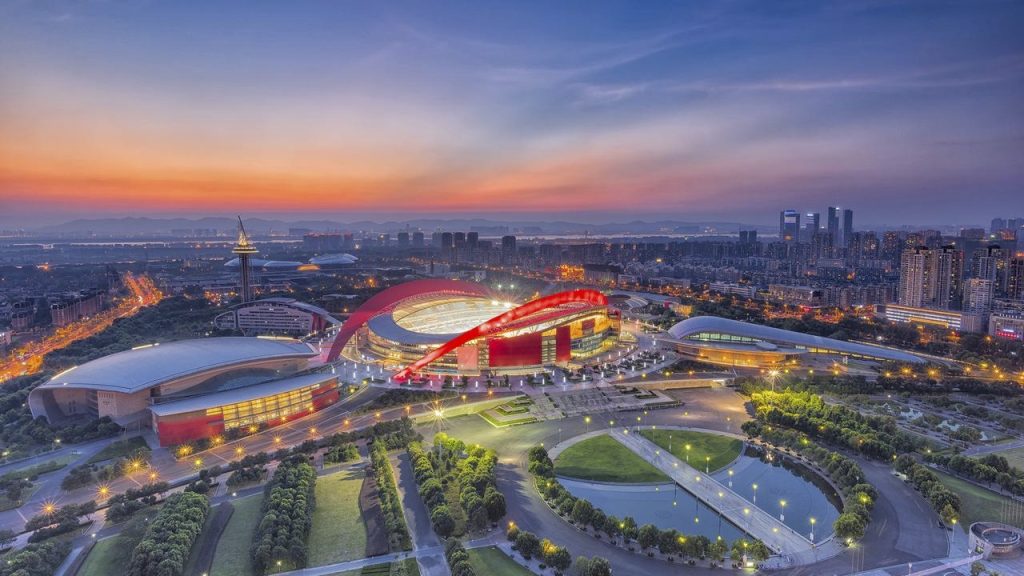
At six o’clock in the morning, the mist over Mo Chou Lake had not yet lifted. On the stone steps in front of Shengqi Tower, an elderly man was practising tai chi facing the lake, his movements as slow as the growth of underwater moss. A gardener pushed a hose along the colonnade; droplets of water splashed onto the Taihu stones, startling the egrets perched on the rockery into flight. The statue of Mo Chou stands beside the pavilion in the centre of the lake, her skirt damp with morning dew. Legend has it that she was a young wife who had drifted here from Luoyang, standing by the lake day after day waiting for someone who would never return. With no visitors yet in sight, the entire garden is so quiet that only the chirping of birds and the sound of water can be heard. It turns out that the true essence of ‘Mo Chou’s mist and rain’ can only be truly appreciated on a deserted morning.
Walking west along Shuixi Men Street, the plane trees lining the street cast enormous shadows. At eight o’clock in the morning, a queue of over twenty people had already formed outside Auntie Xu’s pastry shop on Chanan Fuyuan Street. An elderly lady at the front turns to tell the new arrivals: ‘You’ll have to wait for another batch of green rice dumplings; the ones with salted egg yolk and pork floss sell out the fastest.’ Steam rises from the bamboo steamers, carrying the fragrance of glutinous rice and mugwort. The freshly steamed green rice dumplings with salted egg yolk and pork floss have a soft, chewy skin that almost collapses in the palm of your hand; when you bite into them, the whole salted egg yolk oozes oil and melts on the tip of your tongue along with the pork floss. A local at our table remarked, ‘There’s a queue every day around Qingming; this is actually a quiet day.’ This humble qingtuan has been made quietly for thirty years, growing from a small stall at the end of an alley to become famous throughout the city, all thanks to one word: ‘authenticity’.
At midday, I stepped into the Nanjing Yunjin Museum, where a large hualou loom dominated the entire exhibition hall. Two artisans worked in tandem, one above and one below: the person upstairs was responsible for the jacquard pattern, whilst the one downstairs handled the weft. They could only weave five to six centimetres a day. ‘An inch of Yunjin is an inch of gold,’ said the guide, pointing to the fabric for a dragon robe currently being woven. ‘This pattern uses seventeen colours of silk thread, as well as real gold thread.’ ’ In the museum’s cultural and creative goods section, Yunjin has been transformed into small handbags, ties and scarves, breathing new life into this ancient intangible cultural heritage craft through these everyday objects. The flowing shades of gold and vermilion on those looms evoke the lantern-lit scenes of yesteryear along the Qinhuai River—except that here we are in Jianye, a place where the characters ‘Yunjin’ are embroidered in gold thread.
At three o’clock in the afternoon, the Nanjing Eye Pedestrian Bridge glistened in the sunlight. Two massive elliptical bridge towers resembled a pair of eyes gazing out over the Yangtze River, with steel cables radiating in all directions from their ‘pupils’. Walking across the bridge, the river breeze sent my hair flying in all directions, whilst the waters of the Jiajiang River beneath my feet shimmered like scattered silver. In the middle of the bridge stood a sweet-cotton vendor; the river breeze was stretching the sugar threads into long, fine strands, forcing him to turn sideways to shield himself from the wind. ‘In weather like this, even the cotton candy can’t stand still,’ he said with a laugh. On the opposite bank, Jiangxin Island was lush with greenery, and occasionally a white egret would skim the water’s surface, its wings almost brushing its own reflection.
At dusk, I arrived at Yuzui Wetland Park. A red-and-white lighthouse stood by the riverbank, with the setting sun behind it. The Yangtze River took a bend here, and the view suddenly opened up. People were taking photographs in front of the lighthouse; against the backlight, all that remained were silhouettes and a sky full of orange-red clouds. A photographer carrying a tripod said, ‘Wait half an hour, until the sun sinks between the bridge towers.’ ’ Occasionally, a cargo ship would glide slowly across the river, sounding a single blast of its horn; the sound was swallowed up by the vast expanse of water, leaving only ripples spreading out in concentric circles. Night fell from the east, and the lighthouse came on punctually, casting a warm beam of light into the twilight.
Leaving Yuzui Park late at night, I looked back one last time. The light strips of the ‘Nanjing Eye’ were reflected on the river’s surface, forming two strings of flowing lights, like the Yangtze River’s eyes wide open. The lighthouse was still shining, its red-and-white beams sweeping across the river to warn ships navigating at night. The looms at the Yunjin Museum had long since fallen silent, the steamers at Aunt Xu’s pastry shop had gone cold, and the Shengqi Tower by Mo Chou Lake had melted into the night, leaving only the black silhouette of its eaves.
Jianye District has neither the stone elephants of the Ming Xiaoling Mausoleum nor the painted pleasure boats of the Qinhuai River, but it does have a bend in the Yangtze River here; it has a complete sunset beneath the lighthouse; it has the Yunjin brocade growing inch by inch on the looms; and it has the unchanging gurgle from the clay pots that has remained the same for twenty years. This new district is in no hurry to prove its antiquity; it simply stands quietly by the riverbank, slowly writing its own story with the river’s waters, the lights, the steam and the hearth fires. People come and go, but the river continues to flow, the lights remain lit, and the pastry shop will, as always, raise its first basket of steam at five o’clock tomorrow morning. The vibrant atmosphere of Jianye, like the waters of the Yangtze, flows ceaselessly day and night; it needs not be remembered by anyone, yet it remains here forever.