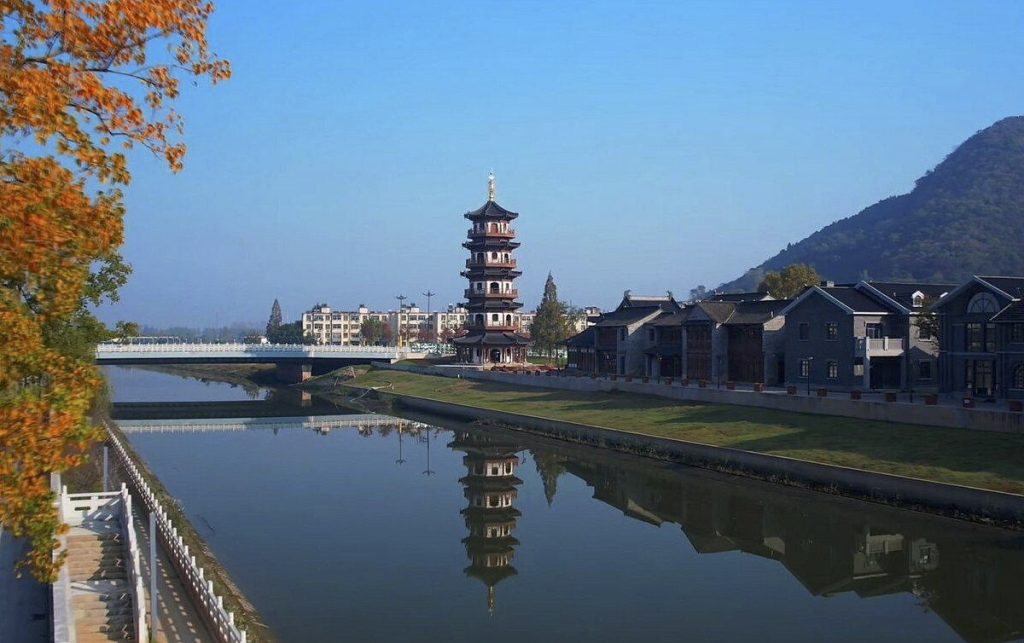
At seven o’clock in the morning, Qixia Mountain was shrouded in a thin veil of mist. The surface of Mingjing Lake was as smooth as an unpolished copper mirror; the reflection of the pavilion in the centre of the lake remained perfectly still, disturbed only by the occasional maple leaf falling to create tiny ripples on the water. A cleaner is sweeping the fallen leaves from the steps; the sound of the bamboo broom sweeping across the stone echoes through the valley. The mountain gate of Qixia Temple has not yet opened, but an elderly man is already waiting outside, clutching three sticks of incense, standing quietly. This temple, first built during the Southern Dynasties, has endured countless burnings and reconstructions, yet devotees continue to arrive punctually at dawn. The bronze rings on the temple gate have been polished to a shine; every scratch conceals an unspoken prayer.
Pushing open the side gate to enter, the Buddha statues of Qianfo Rock gradually come into focus in the morning light. The largest of them, the Buddha of Infinite Life, sits in a stone niche, his countenance serene, a faint, almost imperceptible smile playing at the corners of his mouth. In the adjacent grottoes, the heads of some Buddha statues have weathered away, leaving only their bodies seated upright, as if awaiting something that will never return. A young monk walks past, the hem of his robe sweeping across the stone steps, his footsteps so light they are almost silent. The relief carvings on the stupa revealed intricate textures in the slanting light; the sashes of the celestial dancers fluttered in the breeze, whilst the Bodhisattvas kept their brows lowered and eyes cast down. The craftsmen of the Southern Tang dynasty had carved their vision of the Buddha’s realm into the stone, and a thousand years later, one could still discern the path of the chisel’s edge.
Walking upwards along the mountain path, a few early-reddening maple leaves drifted on the surface of Peach Blossom Lake. The sweetgum trees in front of Taixu Pavilion were still a mottled mix of green and yellow, yet tourists beneath them were already holding up their mobile phones, searching for the perfect angle. A little further up, the sound of voices gradually faded, leaving only the sound of my own footsteps and the occasional birdcall from afar. At the summit of Fengxiang Peak, the stone stele marking the spot where the First Emperor of Qin gazed out over the river stood exposed to the wind; legend has it that he once ascended to this spot to look out over the river. Standing on the very same rock now, the Yangtze River unfurls beneath my feet; its surface is a hazy grey, and the cargo ships resemble slowly drifting leaves. The mountain wind blows fiercely, making the hems of my clothes flutter, reminding me of the verse: ‘The wind is fierce, the sky is high, and the howling of the gibbons is mournful’—though there are no gibbons here, the sense of vast desolation is the same.
On the way down the mountain, I passed the vegetarian canteen at Qixia Temple, where a queue of over a dozen people had formed at the entrance. A bowl of vegetarian noodles was served; the broth was clear and bright, the aroma of mushrooms mingling with the wheat fragrance of the noodles, with a few bright green vegetable leaves floating on the surface. An elderly man sitting opposite me put down his chopsticks and sighed: ‘I come here every autumn; I’ve been eating here for nearly twenty years.’ He pointed to the ginkgo tree outside the window. ‘It wasn’t this big when I first came here.’ Twenty years for a tree is but a fleeting moment for Qixia Mountain, yet for a person, it is long enough to grow old.
At three o’clock in the afternoon, the river breeze from Yanziji swept across my face. The promontory truly resembled a swallow spreading its wings, reaching out towards the centre of the river. Inside the Qianlong Imperial Stele Pavilion, the characters on the stone stele had become somewhat blurred after more than two hundred years of wind and rain. A flock of gulls swept past the headland, their wings almost skimming the water’s surface. A painter sat in a corner with his easel propped up; on his canvas, the river was rendered in leaden grey, with a faint touch of red on the horizon. ‘Waiting for the sunset,’ he said. ‘I’ve been painting here for three years; the colours are different every time.’ On the opposite bank, Bagua Island was reduced to a mere black line in the twilight, with the trees at its tip resembling a row of sentries standing guard.
We walked a stretch along the Muyan Riverside Scenic Belt. At Wuma Du Square, five bronze horse sculptures faced the Yangtze River; legend has it that at the end of the Western Jin dynasty, five horses crossed the river, and one of them transformed into a dragon. An elderly man was flying a kite in the square; it soared high into the sky, its thin string almost invisible in the twilight. A child standing nearby asked his grandfather, ‘What’s that kite?’ The old man replied, ‘It’s a horse.’ The child looked up for a long while and said, ‘There’s no horse—just a string.’ The old man smiled: ‘The horse is at the other end of the string; even an invisible horse is still a horse.’
Qixia District is not the most bustling part of Nanjing, but it has mountains, the river, and the sole surviving temple of the 480 that once stood during the Southern Dynasties. The bells of Qixia Temple ring punctually every morning; the waters of the Yangtze at Yanziji flow ceaselessly eastwards day and night; and though student cohorts come and go at Xianlin, there will always be someone standing beneath a streetlamp on some autumn night, gazing at the moon. The stories of this land have never been sustained by grand, spectacular events, but have been slowly built up by a bowl of plain noodles, a single red leaf, a breeze from the river, and the toll of a bell. Just like that headless Buddha statue on Qianfo Rock, which has stood there in a state of ruin for a thousand years, yet still sits there, neither sad nor joyful, waiting for every falling autumn leaf.